How to Calculate and Increase Your Savings Rate Fast (With Free Excel Tool)

Your savings rate is the single biggest lever on the path to Financial Independence. Without an overview of your savings rate you’re rudderless. Photo by Raimond Klavins on Unsplash.
Reading time: 7 minutes
How to Calculate and Boost Your Savings Rate Fast
Want to stop spending your entire paycheck and grow real savings? In today’s article, you’ll learn how to calculate your savings rate, why it’s the most important factor for reaching financial independence, and how to use a free Excel tracker to take control of your expenses. Whether you’re saving $50 or $500 each month, these steps will help you build a more intentional path to financial freedom—whether your goal is LeanFIRE or FatFIRE.
You can’t manage what you can’t measure. It is not much of an understatement to say that it will be nearly impossible for you to reach financial independence if you don’t have a good understanding of what you are spending your money on.
Even high earners often ask the critical question of “What is my savings rate?” Without tracking expenses, it's easy to lose sight of where money goes. The truth is that without any tracking we become rudderless—it’s very difficult to know where we stand or whether we’re on track to retiring early. For example, a clear grasp of your savings rate can reveal just how feasible something like retiring by age 45 could be with the right adjustments.

Without some minimal level of expenses tracking we’re rudderless. It will be nearly impossible to retire early on your own terms. Photo by Ramon Kagie on Unsplash.
At the end of the day, the savings rate is the most critical ingredient for reaching financial success. It’s important to understand that someone with a very high income but low savings rate will take longer to reach financial independence than someone with a modest salary but implementing an aggressive savings rate.
If this concept is not clear to you, I’d encourage you to play around with our Financial Independence Calculator below. Try implementing different levels of income and expenses, and observe how the timeline to Financial Independence changes.
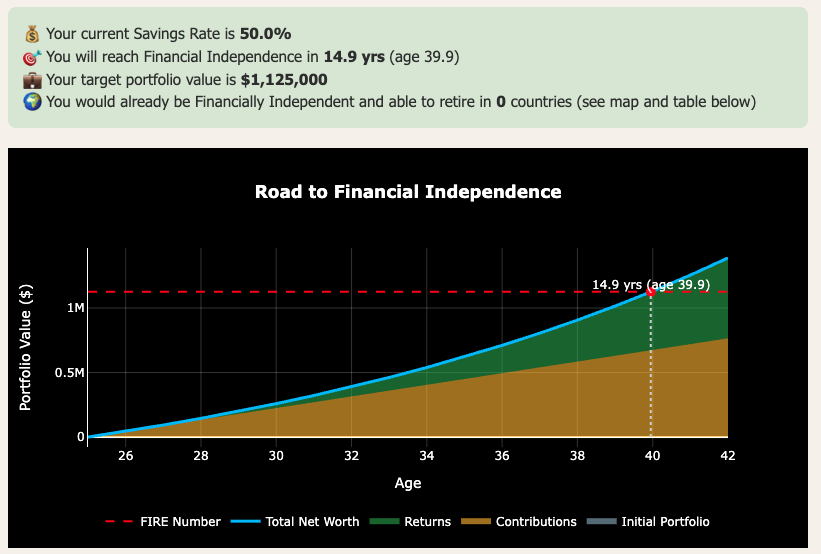
Figure 1: Screenshot of our Financial Independence Calculator—free if you subscribe to our email newsletter. The key insight is that the higher the savings rate the earlier you will be able to retire.
What Is the Formula for Savings Rate and How to Track It
First, we need to know exactly what we’re saving. Your savings rate is simply the percentage of your net income that you don’t spend each month. It’s a critical personal finance metric—yet many people never bother to calculate it.
The formula is as follows:
Savings Rate (%) = (Income – Expenses) ÷ Income × 100
To illustrate with an example, if your monthly net income (after taxes) is $5000, and you spend $4,000 of it, then your savings rate would be 20%.
(5,000 – 4,000) ÷ 4,500 × 100 = 20% savings rate
The savings rate tells you exactly how much of your income you’re keeping each month. Tracking it over time gives you a clear picture of your financial progress—and helps you understand whether you’re on track for your (early) retirement or financial independence goals.
Now that you know how easy it is to calculate your savings rate, the next step is to measure it consistently. There are many ways to do this—apps, notebooks, or spreadsheets—but we recommend using a simple Excel tracker to make the process both visual and repeatable.
Apps can be great as a supplement—or to feed data into your Excel tracker—but keep in mind they come with some risks. For example, Mint shut down in 2024, and many users who didn’t export their data in time lost years of financial history.
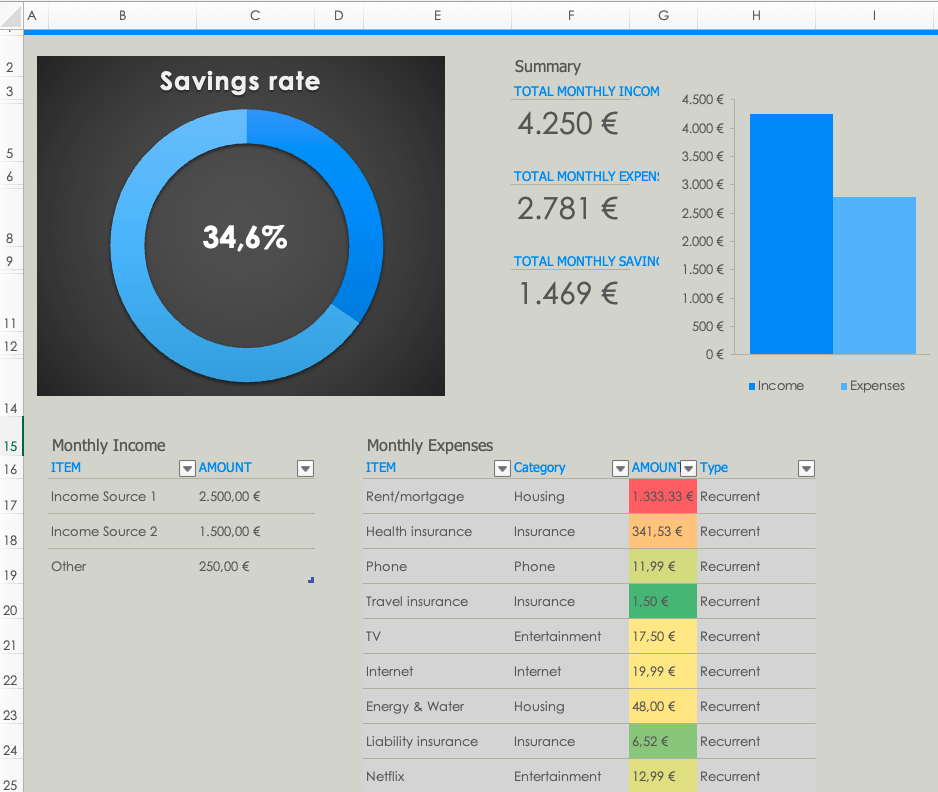
Screenshot of our free Excel Savings Rate Tracker Tool.
Track and Manage Your Expenses with a Free Excel Tool
If you’re wondering how to save more money from your salary or stop spending your whole paycheck, our simple tracking tool can make a huge difference. That’s why we’ve adapted a free Microsoft Excel budget template designed specifically to:
Track your expenses
Optimize your savings rate
Measure your path to financial independence
You can download the free Excel tool here. The first tab (“Sept2023”) includes a sample month to show how everything works.
Here’s how to use it:
Columns B–C capture all household income (after taxes)
Columns E–H let you enter your monthly expenses by category
The spreadsheet automatically calculates your savings rate and displays it prominently—reminding you each time you track your expenses that this is the most important number to optimize on your path to financial freedom.
After reviewing your income and expenses on the monthly tab, don’t forget to open the “Summary” tab. This is where you’ll track your long-term progress toward Financial Independence. Just take the total income and expense numbers from your active monthly sheet (like “Sept2023”) and enter them into columns D and E on the Summary tab.
Then update your current liquid net worth in column H and input your average monthly expenses (and associated financial independence goal) number into cell C1. With this setup, you’ll get a clear view of how much runway you’ve built—and how far you still have to go.
Tracking every single expense may sound tedious at first, but it can also feel very empowering. Consider as well the consequences of not tracking your personal finances. In addition to being rudderless and lack motivation and focus, you will likely extend your career by multiple years (or decades) more than necessary. Why overwork in a career that is not providing you with meaning and fulfillment if you don’t have to?
Over time, you’ll start spotting patterns—impulse spending, unused subscriptions, or seasonal spikes—that give you clarity and control over your financial behavior. What’s important is that tracking helps you align your spending with what really brings you value and set tangible month-to-month goals. The key is to avoid spending on anything that is not providing you with tangible value or joy.
If you’re serious about financial independence, this is your new habit to master. Once you’ve built awareness through tracking, the next step is making room for saving—starting with your paycheck.

Algarve, Portugal. Looking to retire early in Europe? Check out or ranking of best destinations to retire early in Europe. Photo by Diego Gennaro on Unsplash
How to Save More from Your Salary
An easy way to get started is to break down your monthly paycheck into fixed versus variable expenses. Fixed (or recurrent) expenses include items like rent, insurance, or debt repayments—these are the costs that stay pretty much the same each month.
In contrast, variable expenses, like dining out, shopping, or entertainment, tend to fluctuate. Once you separate these two categories it becomes clearer where you have flexibility to cut back or optimize. Sometimes, just categorizing spending in this way helps to reveal a problem you weren’t even aware of.
Another good strategy is to automate your savings by adopting a “pay yourself first” budget. From the different types of budgeting available, I find this one to be the most aligned with pursuing Financial Independence. As the name implies, the very first “expense” to leave your account once the salary is in should be an automatic transfer to your investment accounts, the core of which are hopefully low cost, internationally diversified index funds.
By treating your savings like a recurring bill, you build consistency and reduce the temptation to spend what may feel like surplus cash at the end of the month.
It’s also very helpful to prioritize your essential savings goals, like building an emergency fund (usually, 3-6 months of living expenses), contributing to your retirement investment accounts, or saving for a specific milestone like a deposit for your dream home. When you save money with a goal in mind, you stay motivated, and avoid the common trap of drifting financially. Having goals gives you a sense of direction and urgency.
Still, tracking and categorizing expenses isn’t always enough. Let’s look at the psychological barriers that stop many from saving.

To pursue Financial Independence we need to step out of the ‘keep up with the Joneses’ mentality. Photo by Avi Waxman on Unsplash.
Why People Struggle to Save — and How to Fix It
For many, large hurdles to saving money are emotional. Whether it’s stress relief, boredom, or social comparison, many people spend as a coping mechanism without even realizing it. The solution here isn’t total deprivation, but awareness.
Try to track your purchases for a month and write down whether there was any emotional context behind some of the impulse buys. You may start to see a pattern emerge and work out how to replace reactive spending with more intentional habits that are aligned with your goals.
Another common challenge is lifestyle inflation. As our income grows, there is a natural tendency to upgrade our lifestyle as we progress in our careers. A lot of this has to do with status—over time, though, we realize that this increase in spending didn’t really provide an associated increase in happiness. Unfortunately, if every raise gets absorbed into new spending, our savings rates stays flat.
The key is to lock in part of each bonus or raise towards savings. It’s OK to celebrate a raise with a one-time dinner or trip, but try not to engage in new, increased recurrent expenses. Over time, this discipline compounds and will allow you to create substantial wealth and get closer to Financial Independence.
Finally, many people fail to save because they lack a compelling “why”. Without a clear goal or vision for our future, saving feels to many like a sacrifice with no reward. But if you tie your financial habits to a larger life vision—whether early retirement, more time with your family, or starting a small business—then you create purpose. And purpose is what helps us sustain discipline when motivation runs dry.

Use the 3-question framework below to optimize your expenses. Make sure your spending is aligned with your values and financial goals. Photo by Urban Vintage on Unsplash.
How to Make Smarter Spending Choices With this 3-Question Framework
I’ve found that, as you start tracking your expenses, the next step is learning how to evaluate them. A simple mental model can make this process automatic and much easier for you. I call it the “3-question framework” to help you cut expenses with clarity and intention. Consider the three following questions
How much time does this purchase cost? Each expense comes with a hidden price tag—your time. If something costs $300 and you make $30 per hour, that’s 10 hours of work. Is the purchase still worth it when you frame it in terms of your finite hours of your life? You better love your job, because otherwise many expenses will simply not feel worth it. This question is meant to assess whether a given purchase is bringing value or joy into your life.
How much freedom does this purchase delay? Each dollar you spend today is a dollar you’re not investing towards future financial independence—at its core, you delay your retirement with every single expense. The question is by how much. While small expenses can add up, larger recurring costs—like inflated car payments—can substantially delay your path to financial independence by years. I find that asking this question reorients your purchasing decision to align around your long-term goals.
Does this purchase align with my values? It’s easy to fall into default spending habits—either what others do, our perceived expectations, what’s advertised out there, or simply what feels convenient. But the best financial alignment occurs when your money truly reflects your values. If something doesn’t add joy, purpose, or meaning to your life, why let it drain our resources? I use this final question to make sure my spending honors my priorities, not just my impulses. These values are different for everyone.
Remember—time, freedom, values—how much does the purchase really cost? It’s not just the price tag. Let’s make sure we spend intentionally on what brings us value and joy, and cut back mercilessly on what doesn’t.
Clever Ways to Save Money by Cutting Monthly Bills
An impactful area to optimize spending is by examining your recurring expenses—those predictable, monthly charges that quietly encroach on your income. I found that it’s important to start with a full audit: go through your bank and credit card statements line by line.
Are you still subscribed to platforms or services you’re not using or barely have time to use? Do you have overlapping entertainment services that could be more efficiently serviced; multiple cloud storage plans that could be simplified; or, simply, forgotten magazine subscriptions that hopefully you’ll get the time to read soon?
This simple exercise—and applying the 3-question framework above—often provides us with easy wins that require close to zero lifestyle sacrifice. That’s what we’re going for here—we want to start out by cutting the waste from our budget that is not providing us with value or joy.
After this decluttering, it’s time to optimize what remains. Many providers rely on client’s inertia for their business—they assume most customers won’t bother to switch once they’re subscribed. Let’s prove them wrong. Call your internet, mobile, and utility providers to ask for better deals. Compare offers from competitors and switch if you find a better deal—or if your current provider won’t negotiate.
You’d be surprised to see how often companies offer “retention discounts” just to keep us on board. I see this all the time. I’m already well-optimized, but still have reminders on my calendar when key subscriptions end. Often, you can “pretend” to cancel with a few clicks and voila—they are now offering you a 30% discount to stay with them.
Insurance is another big expense—car, health, home, life, occupational disability, and more. Review your policies annually and shop around. Small cuts in multiple areas compound into serious monthly savings and shave years off your working career.

Together with housing and transportation, food is one of the “big three” categories to optimize. Photo by Joshua Rawson-Harris on Unsplash.
If you’re still looking for more ideas on where to optimize your expenses, check out our recent article with 50 savings tips to accelerate your path to Financial Independence.
To make these changes more exciting, I recommend opening our Financial Independence Calculator in parallel. Every $20-30 you shave off your monthly expenses has a meaningful impact on the length of your working career. I personally find it really helpful to actually visualize these changes.
Yes, perhaps we spent 10 minutes on the phone or with that annoying chat bot online, but now we just reduced my timeline to Financial Independence by 3 months. 90 days of not grinding away for a 10 minute call sounds like a great deal!
When you’re first starting out optimizing your monthly budget, commit to regular monthly reviews. Open your Excel tracker, duplicate the previous month’s sheet and update the numbers for the current month. Then reflect on how you could optimize each expense entry—starting with the recurring ones and then tackling the variable ones.
The entire process of updating your Excel tracker and reviewing your expenses should take no more than 30 minutes per month. Think about it—30 minutes each month for shaving of years of working career. Let’s not search for more excuses and start taking action today.
Best Ways to Grow Your Savings Quickly
While cutting or optimizing costs is a great starting point, don’t forget the second half of the equation—increasing your income. If you want to turbocharge your savings rate, look for ways to increase your earning potential. This could mean negotiating a raise at your current job, looking around to switch jobs, taking on freelance wok, or building a side hustle. Whatever it is, be sure to put 100% of this extra income into your savings and investments, and don’t let lifestyle creep set in.
Another good tactic is to redirect windfalls. Tax refunds, work bonuses, or unexpected cash gifts are perfect opportunities to boost your savings rate without touching your normal budget.
These windfalls are also an excellent way to fast-track your emergency savings without disrupting your monthly cash flow—helping you reach the safety net that makes investing for long-term goals much less risky. By treating windfalls as FI accelerators, not as excuses to spend more, we stay aligned with our bigger goals and priorities.
It’s important as well to consider big-ticket improvements. Can you refinance a loan, downsize your housing, or use public transport instead of a car? These aren’t easy overnight changes, but they can create massive long-term benefits on your budget and path to FI. Remember to start out by considering the big three—housing, transportation, and food.
Some of these changes sound dramatic, but aren’t really. After driving for 7+ years, I let go of my car and have been car-free for the past 13 years! I’m happier than I was before—having a car or not simply does not play into that equation. I use my bike and public transport as my baseline, and use car sharing services or—occasionally—traditional car rentals when I actually need them.
Some people feel they arrived late to the Financial Independence party. Perhaps they are in their mid-to late 30s or even 40s, have a family and many responsibilities. They find it difficult to make changes in their budget. As a father of three, I get it—it’s certainly more difficult to pursue Financial Independence with a family, but it’s certainly more than possible. For these cases, I recommend to start out slowly with pursuing FI with the 1% savings method.

You’re never too late to the Financial Independence game. If you find it hard to cut your expenses, try the 1% Savings Method for Financial Independence. Photo by Dino Reichmuth on Unsplash.
Final Thoughts: Small Shifts, Big Results
Ultimately, mastering your savings rate is not about perfection—but about progress in the right direction and consistency. Whether you just started to track your monthly expenses or are already deep into optimizing your budget, every small step compounds over time.
I’ve found that the simple act of calculating and improving our savings rate gives us control, clarity, and confidence in our financial independence journey. With the right tools and a mindset focused on long-term freedom, you’re no longer rudderless, but making giant leaps towards engineering your early retirement—at the LeanFIRE or FatFIRE level that fits your lifestyle goals.
Remember, Financial Independence isn’t reserved for high earners or finance geeks. At it’s core, Financial Independence is available to anyone willing to be disciplined—to align their spending with their values, invest consistently, and build habits that support their financial goals. The sooner you start making small changes, the sooner you’ll start seeing big results.
👉 If you’re ready to take the first step, check out our Start Here guide—it’s the best place to begin your FI journey.
💬 Have questions or want to share your own experience? Drop a comment below—I’d love to hear where you are in your journey, and what you're working on next.
🌿 Thanks for reading The Good Life Journey. I share weekly insights on money, purpose, and health, to help you build a life that compounds meaning over time. If this resonates, join readers from over 100 countries and subscribe to access our free FI tools and newsletter.
Enjoyed this post? Don’t miss our insights on the “Crossover Point” of financial independence or on how to invest your hard-won savings. Didn’t find what you were looking for? Check out our latest articles below.
Disclaimer: I am not a financial adviser, and this content is for informational and educational purposes only. Please consult a qualified financial adviser for personalized advice tailored to your situation.
About the author:
Written by David, a former academic scientist with a PhD and over a decade of experience in data analysis, modeling, and market-based financial systems, including work related to carbon markets. I apply a research-driven, evidence-based approach to personal finance and FIRE, focusing on long-term investing, retirement planning, and financial decision-making under uncertainty.
This site documents my own journey toward financial independence, with related topics like work, health, and philosophy explored through a financial independence lens, as they influence saving, investing, and retirement planning decisions.

Paradise beach in Thailand. Looking to retire early in Asia? Check out or ranking of best destinations to retire early in Asia. Photo by M o e on Unsplash.
Check out other recent articles






























Frequently Asked Questions (FAQs)
-
A good savings rate for financial independence typically starts around 20–25%, but the higher, the better. Many pursuing early retirement aim for 40–60% or more to dramatically shorten their working years. The key is consistency and adjusting based on your income and goals.
-
Your savings rate is calculated as:
(Income – Expenses) ÷ Income × 100.
For example, if you earn €5,000 and spend €4,000, your savings rate is 20%. This simple formula gives clarity on how much you keep versus spend each month. -
You can’t improve what you don’t measure. Without tracking, it’s easy to feel lost financially. Knowing where your money goes helps you identify waste, increase your savings rate, and stay aligned with long-term goals like early retirement or more lifestyle freedom.
-
While there are apps, we recommend using our free Excel Savings Tracker, which is visual, repeatable, and doesn’t rely on third-party platforms that may shut down (like Mint did). It gives you full control over your data and progress.
-
Start by cutting recurring expenses like unused subscriptions or overpriced utilities. Then automate savings, apply the “pay yourself first” method, and avoid lifestyle inflation. Using our Financial Independence Calculator helps visualize how these changes accelerate your timeline. Check out our 50 savings tips to accelerate your budget optimization.
-
Common pitfalls include emotional spending, lifestyle creep, lack of financial visibility, and no clear “why.” Overcoming these requires tracking, mindset shifts, and linking money habits to meaningful life goals—like freedom, purpose, or time with family.
-
Even cutting €30–50 per month can move your Financial Independence date forward by months. Use our calculator to see how small wins, repeated over time, reduce your need to work longer—proving that little changes truly add up.
Join readers from more than 100 countries, subscribe below!
Didn't Find What You Were After? Try Searching Here For Other Topics Or Articles: