
Photo by Vincentiu Solomon on Unsplash.
Reading time: 6 minutes
Quick answer:
Renting often wins for FIRE (Financial Independence, Retire Early) when the buy price is high relative to rent and you invest the difference consistently in the stock market. Buying can still win when prices are reasonable, you stay long-term, or you won’t invest otherwise. This guide shows the break-even logic using a 30-year model and how each choice shifts your Financial Independence timeline.
What you’ll get from this guide
✔ A clear rent-vs-buy framework (unrecoverable costs + opportunity cost)
✔ A 30-year net worth comparison under transparent assumptions
✔ A “years-to-FI” comparison (why net worth ≠ FI)
✔ The biggest assumptions that changes the result
✔ A template so you can plug in your own numbers
TL;DR — Rent vs Buy for Financial Independence 📊🏠
🏠 Renting can speed up Financial Independence when property prices are high and you invest the difference
💸 Buying builds home equity, not income, which can slow an early-retirement timeline
📉 Monthly cash-flow differences compound for decades, shaping your FI date more than price alone
🧠 Behavior matters as much as returns—a mortgage can act as forced savings for non-investors
⏳ Longer time horizons favor buying, while renting preserves flexibility during FI-building years
🧮 The rent-vs-buy decision ultimately changes how many years you must work, not just your final net worth.
Financial Independence and the Decision to Rent or Buy a Property
Pursuing Financial Independence to Buy your Freedom Back
Reaching Financial Independence (FI) means having enough invested assets to cover your living costs without relying on paid work. While many people reach this point only at traditional retirement age, disciplined saving and long-term investing can make it possible much earlier.
On this site, early retirement isn’t about escaping work—it’s about buying back time to focus on meaningful projects, health, family, and contribution.
Which brings us to one of the biggest financial decisions affecting that timeline: whether to rent or buy a home.
Should You Rent or Buy a Home?
Today, we explore a controversial topic in personal finance—whether it makes sense to rent or buy a property. Specifically, we will evaluate several different scenarios that consider house renting and buying to determine the following financial outcomes:
The differences in net worth after a 30 year period for each scenario, given a set of assumptions, and
The potential implications of both paths for your pursuit of Financial Independence. Does buying a house slow down, accelerate, or have no effect on your timeline to achieving FI?
The renting vs buying a home debate is complex, involving financial and lifestyle considerations, where presenting a few individual scenarios that are relevant to some people may not be applicable to others. However, my hope is that going through this process you may be in a better position to evaluate the different factors at play that are relevant to your personal situation.
At the end of the article, I will provide a link to the excel template that underlies all the numbers and graphs presented so you can tailor the calculations to your situation.
The debate on renting versus buying a home is often emotional and complex. I get it; there are a lot of personal, non-financial factors involved in this decision: for some, this is a lifestyle choice—some may choose simply to have a larger space for their growing family or prefer to have more control over their living situation.
In some countries, the need and/or pressure to conform to societal expectations and achieve status through home ownership can also play a role. Over time, many of us face questions from family and friends about why you haven’t bought a home yet.
In some cases, these are difficult conversations to have, because the person you are talking to may have already settled on a specific path long ago. Nobody wants to hear that their decision wasn’t “correct” or realize that they probably didn’t think their decision through. In other words, they may already be heavily invested in their decision—both emotionally and financially.
Renting vs Buying a Home: Impact on Financial Independence Explained
Assumptions for Comparing Renting vs Buying a Home
Table 1 summarizes the two scenarios under analysis. In both Renting and Buying Scenarios, the household income is $7,450 monthly after tax, with an initial $140,000 in savings. In the Renting Scenario, the household rents a comfortable apartment for $2,000 per month, which is adjusted upward 2% per year to account for inflation.
In this scenario, we invest the initial $140,000 in an internationally diversified, low cost index fund, which we assume is held for the long term with an average 7% return on investment. Given the objective of pursuing early Financial Independence, the household in this scenario has an aggressive 40% savings rate and manages to invest $3,000 per month in their portfolio of index funds.
In the Buying Scenario, $140,000 is used for a 20% down payment on a $700,000 home in the outskirts of the city, taking on a mortgage for $560,000. The mortgage assumes a 3.6% interest rate, and, given a 30-year mortgage, a $2,569 fixed monthly payment over the entire period. In addition, we consider annual property taxes (1% of home value), maintenance costs (1% of house value), and insurance costs (0.35% of house value).
These categories of unrecoverable ownership costs are closely related to the well-known5% rule for renting versus buying, popularized by Ben Felix, which estimates that roughly five percent of a home’s value per year is lost to taxes, maintenance, and the opportunity cost of capital. This rule provides a useful sanity check when comparing housing costs across markets. We’ve explored it further in other posts, e.g., related to overcoming housing FOMO.
All these items bring the real monthly costs of home ownership from $2,569 to $3,940—highlighting how, in this modeled scenario, owning can cost significantly more per month than renting once taxes, maintenance, insurance, and financing are fully considered. Since there is about $2,000 less to invest each month in this scenario, we only consider $1,000 monthly contributions to a diversified, low-cost index fund in the Buying Scenario. Finally, we assume an average 3% home appreciation rate over the 30-year period.

Table 1: Summary of assumptions used under the home Renting versus Buying Scenarios.
Renting vs Buying a Home: Detailed Financial Results
There are several interesting points to unpack here, so let’s go step by step. First, even though the value of the house was $700,000 and we took on a mortgage of $560,000 it is important to understand that we would end up paying a total of $925,000 over the 30 year period (Figure 1): $560,000 would go towards the principal payment plus another $365,000 as interest on the loan.

Figure 1: Annual mortgage payments disaggregated by principal and interest.
Now, let’s consider how the index fund investments did under both scenarios. The Renting Scenario considered an initial $140,000 plus $3,000 monthly contributions, while the Buying Scenario started at 0$ and added $1,000 monthly contributions. Ongoing contributions are adjusted annually for 2% inflation in both scenarios.
As observed in Figure 2, in the Renting Scenario, you would end up, after 30 years, with a whopping $7.3M vs 2.0M in the Buying Scenario. Of course, such a large difference ($5.3M or $2.9M in today’s money) was to be expected, given the difference in contributions. But to make a fair comparison, we need to consider the equity in the house, which is an important part of the net worth in the Buying Scenario.

Figure 2. Index fund investments after a 30-year period under the Renting versus Buying Scenarios.
Factoring in home equity makes the Buying Scenario more competitive. However, as observed in Figure 3, the total net worth after 30 years of the Renting Scenario is still superior $7.3M versus $3.6M, a $3.7M difference ($2.0M in today’s money).
This pattern is not unique to our assumptions. Recent mainstream housing-market analyses similarly find that renting can be materially cheaper than buying once total ownership costs are included, reinforcing that the financial comparison depends heavily on local prices, time horizons, and behavioral assumptions.

Figure 3. Total net worth after a 30-year period under the Renting versus Buying Scenarios.
Financial Independence: Renting Versus Buying Scenario
Let’s assume that after seeing this difference in final net worth you are still comfortable with buying the house. After all, this is also an emotional, lifestyle decision, and clearly both scenarios end up with a very high net worth as a result of implementing a high savings rate.
The monthly living costs of the household under both scenarios are $4,450 (household income of $7,450 minus the $3,000 invested each month). Using the 4% rule, achieving Financial Independence would require around $1.3M in income-generating assets to be considered financially independent ($4,450 x 12 ÷ 0.04).
In the Renting Scenario, you would reach this net worth after roughly 15 years. In contrast, in the Buying Scenario you would reach it after 22 years, but with one critical caveat: a large part of your net worth is tied to your home equity, i.e., it is not an income-generating asset. If you consider only the index funds of the Buying Scenario, unfortunately you wouldn’t reach the $1.3M (in today’s money) mark even after 30 years.
Where This Model Breaks Down
The results presented here depend heavily on local assumptions made such as:
(1) the price-to-rent ratio in my area,
(2) realistic maintenance, taxes, and transaction costs,
(3) long-term investment returns, and
(4) whether you consistently invest the monthly savings from renting.
In this specific model, renting remains financially ahead even over a 30-year horizon, mainly because the higher ownership costs significantly reduce invested capital and long-term compounding.
However, in markets with lower price-to-rent ratios, stronger home appreciation, or weaker investing discipline, buying can still outperform by effectively acting as forced savings.

Photo by Flo Pappert on Unsplash.
When Buying Can Still Make Financial Sense
It’s important to note that the high savings rate (40%) considered translates into investing an aggressive $3,000 per month in the renting scenario. The more aggressive your savings rate, the larger the difference will be in net worth between the Renting Scenario and the Buying Scenario. The difference in net worth between both scenarios would reduce to zero if the Renting Scenario only invested $500 per month versus $0 per month in the Buying Scenario.
Even though the house appreciates at a lower rate (3%) than the index funds (7%), in this particular case you are investing overall larger amounts of money into home equity. Simply put, investing more money at a 3% return can outperform minimal investments at 7%.
This illustrates an important conclusion: for those who are not willing to invest aggressively in the stock market and for those who are not willing to buy and hold their stock investments over the long term, buying a property can make perfect financial sense. After all, paying a mortgage does force disciplined savings for those not inclined to invest.
Discussion of Assumptions Used and Disclosures
We consider here a conservative 20% down payment, although in many countries a smaller percentage may be possible, e.g., 10%. Decreasing the down payment would further hurt the Buying Scenario in relation to the net worth results presented above.
There are numerous assumptions in Table 2 which may not apply to everyone or for all locations. For example, rent may increase at higher rate than 2% per year in some locations. This 2% per year is actually locked in in my apartment rental contract, so it is not an unrealistic assumption either. Similarly, an average house appreciation of 3% seems reasonable as a benchmark, but this varies very strongly over time and location. On the other hand, please consider whether it is realistic for real estate markets that have experienced unbelievable growth over the last decade/s to continue to do so 30 years into the future.
I don’t live in the US. A lot of the assumptions included in this exercise are tailored to the specific circumstances of where I live, which may not apply to you. House prices, interest rates, and other assumptions disclosed in Table 1 can vary substantially from country to country. Feel free to download the excel template and adjust the assumptions to your specific situation.
Disclosure: this post is for educational purposes only, intended to help readers think through the numerous factors involved in making this decision. Buying a house can be wonderful, but for many there are important tradeoffs to consider, especially related to your ability to reach Financial Independence.
For readers who prefer to stay flexible and still benefit from real-estate returns without taking on a mortgage, there are also indirect ways to gain exposure to property markets—such as through REITs (Real Estate Investment Trusts). And for those who have already bought and are weighing whether to overpay the mortgage or invest the surplus, our mortgage vs investing guide works through the maths and the FIRE-specific considerations in detail.
If you enjoyed today’s article, here are some next steps:
👉 Estimate your FI timeline with our free FI Calculator (email unlock)
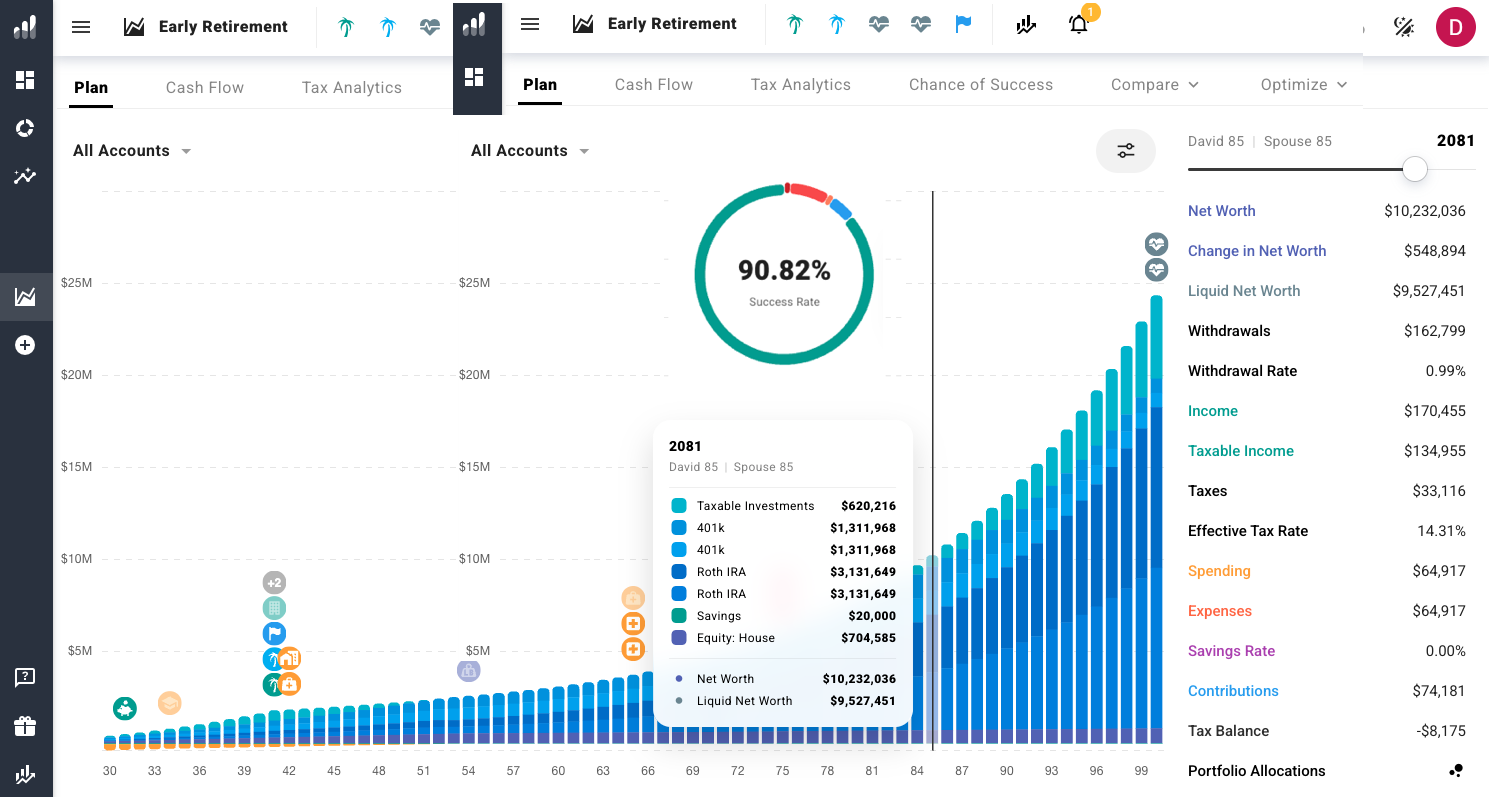
👉 Compare buying vs renting on your own financial plan—add a home purchase and watch your FI date move: see our ProjectionLab walkthrough
👉 Subscribe to access free tools and our monthly newsletter with new articles and insights
👉 Explore a detailed post on how to deal with housing FOMO when everyone around you is buying.
🌿 Thanks for reading The Good Life Journey. I share weekly insights on personal finance, financial independence (FIRE), and long-term investing — with work, health, and philosophy explored through the FI lens.
Disclaimer: I am not a financial adviser, and this content is for informational and educational purposes only. Please consult a qualified financial adviser for personalized advice tailored to your situation.
About the author:
Written by David, a former academic scientist with a PhD and over a decade of experience in data analysis, modeling, and market-based financial systems, including work related to carbon markets. I apply a research-driven, evidence-based approach to personal finance and FIRE, focusing on long-term investing, retirement planning, and financial decision-making under uncertainty.
This site documents my own journey toward financial independence, with related topics like work, health, and philosophy explored through a financial independence lens, as they influence saving, investing, and retirement planning decisions.
Check out other recent articles





























Frequently Asked Questions (FAQs)
-
Renting often leads to earlier FI when home prices are high and the savings difference is invested consistently. Buying can still work well when prices are reasonable, you stay long-term, or investing discipline is low.
-
In this model, buying delays FI by roughly seven years. The exact impact depends on ownership costs, investment returns, and how much monthly cash flow is reduced.
-
Because FI requires income-producing assets. Home equity may increase net worth, but it does not generate cash flow unless you sell, downsize, or borrow against it.
-
Buying becomes more favorable with long holding periods, lower price-to-rent ratios, strong appreciation, or when renters fail to invest the savings difference.
-
Price-to-rent ratio, investment returns, ownership costs, time horizon, and investor behavior all strongly influence the result.
-
Yes. Small differences in rent, returns, or time horizon can shift the outcome significantly—so personalized modeling is essential.
Join readers from more than 100 countries, subscribe below!
Didn't Find What You Were After? Try Searching Here For Other Topics Or Articles: