
Photo by Jakob Owens on Unsplash.
Reading time: 7 minutes
Quick answer:
The guardrail withdrawal strategy (GWS) is a flexible retirement spending system where you set a starting withdrawal rate—commonly 5% for early retirees—and adjust automatically based on portfolio performance. If markets do well and your withdrawal rate drops below 4% of your current portfolio, you give yourself a spending raise (typically 10%). If markets fall and your rate climbs above 6%, you cut spending by 10%. The result: a portfolio that stays sustainable through market cycles, without the rigidity of a fixed withdrawal rule—and a potentially earlier retirement date.
What you'll get from this article:
✔ A plain-English explanation of the guardrail withdrawal strategy
✔ How it compares to the 4% rule—advantages and limits
✔ An example showing exactly how guardrails function in practice
✔ Why a 5% starting rate can let you retire sooner
✔ Who the strategy works for—and who should be cautious
TL;DR — Guardrail Withdrawal Strategy 🛡️
📐 Start at 5% withdrawal—higher than the 4% rule, but with built-in guardrails
📈 Markets up? Your rate drops below 4% → give yourself a pre-set raise (typically 10%)
📉 Markets down? Your rate climbs above 6% → cut spending by a pre-set amount (typically 10%)
🏁 Retire sooner—a 5% rate means a smaller target portfolio ($800K vs $1M for $40K/year)
⚠️ Only works if you have genuine spending flexibility—not suitable for lean or fixed budgets
What Is the Guardrail Withdrawal Strategy?
The 4% rule is a useful starting point for retirement planning—but it has a fundamental flaw: it's very rigid. It doesn't care whether markets are up 30% or down 20%. You withdraw the same inflation-adjusted amount regardless. For conventional retirement timeframes this may not be a problem, but it can be for FIRE (Financial Independence, Retire Early) folks.
The guardrail withdrawal strategy, developed by financial planner Michael Kitces, fixes this. It lets your spending flex with market conditions—within pre-set limits—so you can retire earlier, spend more when things go well, and protect your portfolio during periods where the market underperforms.
This article explains how it works, when to use it, and whether it's right for your situation. For the full picture of all major withdrawal strategies—including VPW, bond tents, and CAPE-based approaches—see our complete guide to safe withdrawal rates.
To understand why guardrails are an improvement, it helps to start with a quick recap of the 4% rule and where it falls short.
How Does the 4% Rule Work in Practice?
According to the 4% rule, for a 30-year period, you could expect to retire with a portfolio holding at least 50% in stocks—a 50/50 stocks-to-bonds split works, as does a more equity-heavy 75/25 allocation—and sustainably withdraw 4% each year (adjusted for inflation) without too much fear of running out of money, even after taking care of your expenses during the entire retirement period.
Here is a simple example. Let’s suppose you are 65 and ready to retire. You have $1M dollars invested in your portfolio, a combination of stocks (low cost index funds) and bonds (50%-50%). Following the 4% rule, your portfolio withdrawals in retirement to cover expenses would take place as follows:
Year 1: you withdraw $40,000 (4% of $1M)
Year 2: you withdraw $41,200 (after adjusting for a 3% inflation that took place during year 1).
Year 3: you withdraw $42,024 (after adjusting for a 2% inflation that took place during year 2)
Rinse and repeat for the following years of retirement.
Advantages of Using the 4% Rule
The “4% rule” can become your guiding star. The “4% rule” can be incredibly powerful at the start of your wealth accumulation phase. At the beginning of your investing journey, it can serve as a compass when trying to respond to the question of how much money you really need to be financially independent or to be able to retire. According to the rule, it amounts to 25 times your annual expenses. For example, if you envision needing $40,000 in retirement, you would aim at first to accumulate roughly, a $1,000,000 portfolio ($40,000 x 25).
The “4% rule” allows you to draw a timeline to retirement. You not only have a guiding Financial Independence number to work towards, but it is also fairly easy to estimate how long it takes to achieve it, under a series of assumptions. We use provide a free FI Calculator in this blog (email unlock) to understand how different factors affect our timeline to achieve financial freedom and early retirement.
The “4% rule” can be a very powerful framework to analyze lifestyle choices. It can help you understand how changes in expenses affect your timeline to reaching Financial Independence. You can therefore evaluate differences in lifestyle not only in absolute dollar terms, but also in terms of time—you can literally understand what a certain expense or lifestyle choice means in relation to the length of your working career.
Disadvantages of Using the 4% Rule
Always be careful with applying too rigidly any rule in personal finance. The very creator of the 4% rule, Bill Bengen, suggests it should be thought of as a rule of thumb, not a rule of nature—and has since updated his own thinking, raising the rate to 4.7% with a more diversified equity portfolio. The core lesson: rigidity is the enemy of a good withdrawal strategy.
The 4% rule was not conceived for early retirees. As mentioned earlier, it is important to note that the study the 4% rule is based on was targeting traditional retirees with a 30-year retirement horizon. Anyone wishing to retire early should view this rule with extra caution; not only will their retirement be potentially longer because they leave the workforce earlier, but their life expectancy could also potentially surpass that of previous retiree cohorts.
The 4% rule calls for an aggressive asset allocation that not everyone can stomach. Everybody’s investing risk tolerance is different. Asset allocations of stocks/bonds ranging from 75-25 to 50-50 are perceived as aggressive by many. It is important to remember that having a large share of your wealth in a volatile asset class like stocks calls for a perfect behavior from the investor: the investor must be very disciplined and avoid selling when markets periodically take a tumble.
The original study underlying the 4% rule used US data only. Subsequent studies have examined how the 4% rule would have performed historically outside the US. Surprisingly, although it worked in the US, Canada, and Australia, it was unsuccessful in 18 other countries of the dataset. You shouldn’t be investing only in your home country in the first place (research if needed the pitfalls of “home country bias”), but if you are, then the 4% rule calls, at the very least, for extra care.
How Can we Improve the 4% Rule in Practice?
The main disadvantages of the 4% rule can be overcome by adopting a mindset of flexibility. It is important to pay attention to what the market is doing and adapt your spending accordingly. You don’t have to do this on a 1:1, ratio i.e., if the market goes down 20%, you don’t need to reduce your spending by 20%, or vice versa. But you do need a buffer for both cases. Better withdrawal “rules” than the 4% rule should consider variable spending strategies.
Building a Guardrail Withdrawal Strategy (GWS)
This variable spending strategy is suggested by financial advisor Michael Kitces. In practice, it means withdrawing within a “safety lane” that is limited by 2 guardrails that allow you to modify your withdrawal rates if the market is either underperforming or overperforming beyond a given threshold.
A useful analogy is to think of this strategy as using bumper rails in the bowling alley (see picture below). No matter how poorly you throw the ball, the bumper rails correct its trajectory and allow it to reach its final destination at the end of the lane. In this case, the correct destination is “not ever running out of money.” Next, we will see an example of how to apply this strategy in practice.

Figure 1. As an analogy, think of the Guardrail Withdrawal Strategy (GWS) as the bumper rails found in bowling alleys. Guardrails make it really hard to miss the mark. Photo from: murreybowling.com
Applying the Guardrail Withdrawal Strategy in Practice
According to the GWS, you begin by setting a starting withdrawal rate—5% is a common and reasonable choice for early retirees, though your own rate will depend on your timeline, flexibility, and risk tolerance. You then adjust that amount for inflation in subsequent years.
If the market has performed strongly over the initial years and you find yourself withdrawing 4% or less of your current portfolio, you have hit the lower guardrail—you are spending too little and can give yourself a pre-set raise, typically 10%. If you were planning to withdraw $50,000 for that year, you could take $55,000 instead.
Analogously, if the market is steadily underperforming over the first years of retirement and you find that your annual withdrawal now represents 6% or more of your current portfolio, it is time to be a bit more conservative and protect the long-term longevity of your portfolio. You can reduce your withdrawal by 10%: if you were planning to withdraw $50,000, you should aim for taking $45,000 instead.
Advantages of Using the Guardrail Withdrawal Strategy
Applying the GWS, you are guaranteed to not run out of money during retirement. However, this approach does mean you need some built-in flexibility in your portfolio on retirement. If you can’t afford to take a 10% cut in your spending, then this variable spending strategy will not work for you.
Following the GWS will ensure you fully enjoy the benefits of your portfolio. When your spending lands well below your planned budget—thanks to strong market performance—those surpluses can be more than just “extra padding.” They can also be deployed toward strategic, higher-upside opportunities, if they align with your risk tolerance and goals. We explore this mindset further in our piece on building an antifragile approach to Financial Independence.
Everyone likes to focus on the few cases were the 4% rule doesn’t work, but forgets to mention that in the vast majority of analyzed scenarios you end up with a portfolio that is several folds larger than it was when you retired. Following this variable spending strategy ensures you enjoy the fruits of your labor.
Applying the GWS means you may be able to actually retire sooner. By using a 5% initial withdrawal rate, you could potentially retire with a smaller nest egg and therefore shorten your working career. Under the 4% rule, you needed $1M to retire, assuming an annual spend of $40,000. Using an initial 5% withdrawal rate instead means you could potentially pull the trigger sooner, with a smaller $800,000 portfolio ($40,000/0.05). As mentioned earlier, this works only if you have the ability to be flexible—if you are unlucky, a few years from now you may have to rely on $36,000 (following the 10% cut).
If you enjoyed this article, here are some next steps:
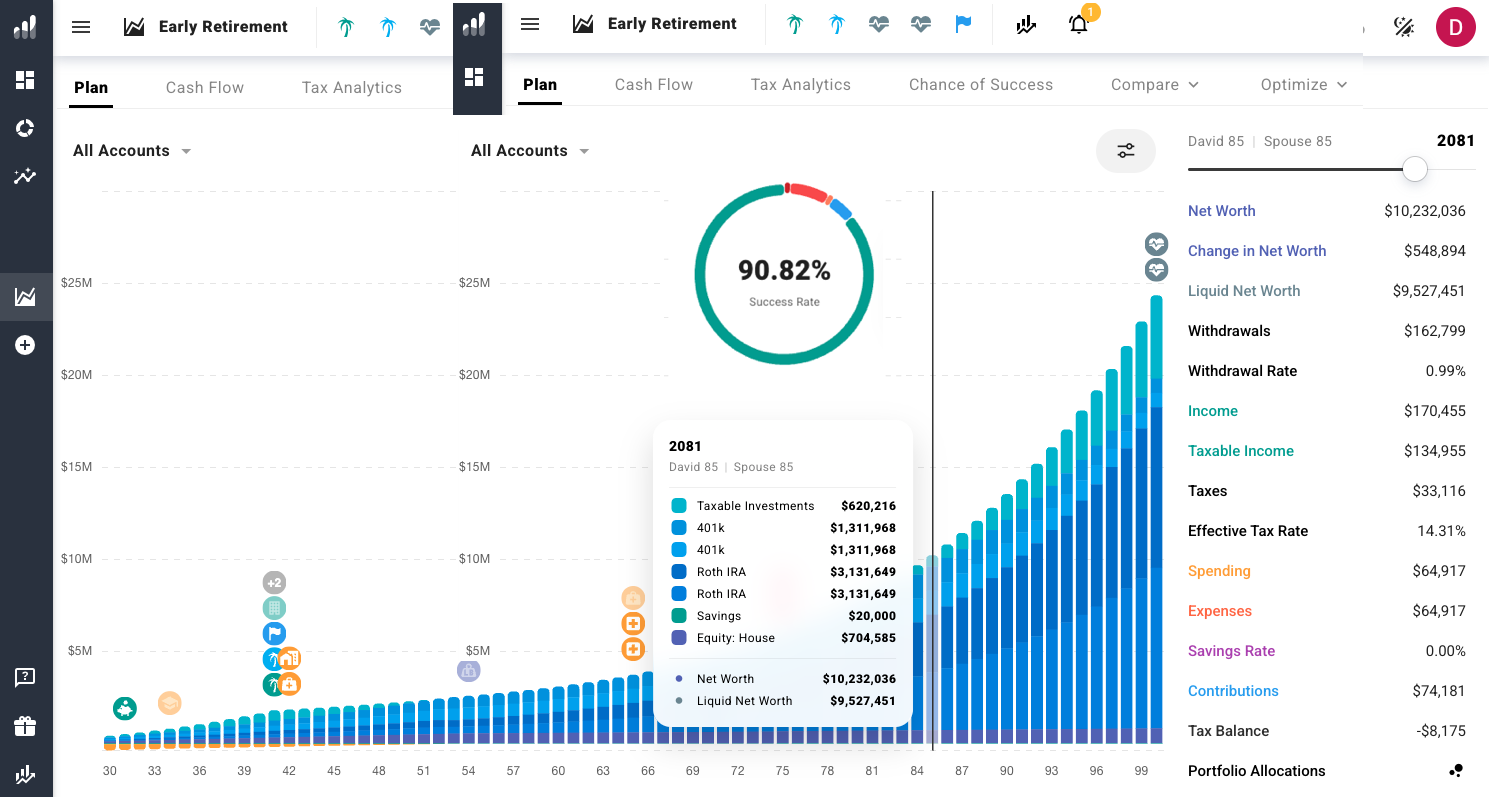
👉 See whether a 5% guardrail plan actually survives your own numbers—stress-test it against market history: see our ProjectionLab walkthrough
👉 New to FI? Start with our complete guide to Financial Independence and early retirement
👉 Want all withdrawal strategies in one place? See our complete guide to safe withdrawal rates
👉 Browse 130+ articles on FI, investing, work, and health at The Good Life Journey
👉 Subscribe to get free FI tools and the weekly newsletter (one-click unsubscribe anytime).
🌿 Thanks for reading The Good Life Journey. I share weekly insights on personal finance, financial independence (FIRE), and long-term investing — with work, health, and philosophy explored through the FI lens.
Disclaimer: I am not a financial adviser, and this content is for informational and educational purposes only. Please consult a qualified financial adviser for personalized advice tailored to your situation.
Check out other recent articles





























About the author:
Written by David, a former academic scientist with a PhD and over a decade of experience in data analysis, modeling, and market-based financial systems, including work related to carbon markets. I apply a research-driven, evidence-based approach to personal finance and FIRE, focusing on long-term investing, retirement planning, and financial decision-making under uncertainty.
This site documents my own journey toward financial independence, with related topics like work, health, and philosophy explored through a financial independence lens, as they influence saving, investing, and retirement planning decisions.
Join readers from more than 100 countries, subscribe below!
Didn't Find What You Were After? Try Searching Here For Other Topics Or Articles: