
José Ignacio, Departamento de Maldonado, Uruguay. Uruguay ranked 2nd in our top 5 retirement destinations in Latin America. Photo by Pedro Slinger on Pexels.
Reading time: 7 minutes
What Is Bengen’s 4.7% Rule (and Why It Matters for Retirement)
Quick answer: Bill Bengen’s updated 4.7% rule suggests that a well-diversified retirement portfolio could have supported higher withdrawals than the traditional 4% rule, without running out of money over 30 years, even in worst-case historical scenarios.
In this article, I explain what the 4.7% rule actually is, how Bengen tested it, when it applies (and when it doesn’t), and how early retirees can use it safely (often with more flexibility than a fixed rule allows).
👉 For a complete map of all major withdrawal strategies—from the 4% rule through to dynamic approaches like guardrails, variable percentage withdrawal (VPW), and the bond tent—see our complete guide to safe withdrawal rates for early retirees.
TL;DR — The 4.7% Rule at a Glance
📈 4% Rule (Original): 4% withdrawals, designed for 30-year retirements on US stocks & bonds
💡 4.7% Rule (Updated): Bengen’s more diversified portfolio supports a higher safe rate
🧮 Portfolio Mix: 55% diversified stocks, 40% bonds, 5% cash, tested across 400 historical periods
⏳ FIRE Implication: Reach Financial Independence sooner, with ~15% less savings than the 4% rule
🧘 Long-Term Caution: For 40+ year retirements, stay conservative or go dynamic (guardrails, VPW)
🛠️ Best Practice: Pair diversification with spending flexibility for the safest early retirement
What Is the 4% Rule—and Why Bill Bengen Updated It
The 4% rule is a popular retirement planning guideline that helps determine how much you can safely withdraw from your investment portfolio each year without running out of money. Think about it: if you withdraw too much money on an annual basis, you risk running out of money in the later years of your retirement.
In contrast, if your annual spend is too small, you’re not only missing out on the fruits of your labor, but you may also have been able to retire much earlier. The 4% rule (of thumb) is commonly seen as a balanced middle ground between these two extremes.
Recently, Bill Bengen—the creator of the rule—has updated his recommendation. In his updated analysis, which includes a more sophisticated and diversified portfolio, he now advocates for using a less conservative 4.7% withdrawal rate. If one were to follow his recommendation, this would mean aiming for a smaller retirement nest egg that would allow you to retire sooner and potentially have more healthy, active years ahead. Sounds great, right?
How the 4% Rule Helps You Calculate Your Retirement Number
The 4% rule is a powerful Financial Independence strategy useful during both wealth accumulation and retirement. At the beginning of your investing journey, it can act as a guide to determine how much money you need to accumulate in order to achieve Financial Independence and step away from your career. According to the rule, it amounts to 25 times your annual expenses. For example, if you envision needing $60,000 in retirement, then you would aim to accumulate a $1.5M portfolio ($60,000 x 25 or $60,000/0.04).
Following this example, during the first year of retirement, you would withdraw 4% of the portfolio, i.e. $60,000, and adjust in subsequent years for inflation to maintain the same level of purchasing power. It represents a “set and forget” strategy; once you retire, you withdraw a fixed amount on an annual basis, irrespective of market fluctuations, portfolio growth, or longevity considerations.
There is substantial nuance related to this rule. I recommend revising our coverage of its advantages and disadvantages in our previous post. However, for the purposes of today’s post, it is important to remember that the data underpinning this rule considered only 2 asset classes: both large cap US stocks and intermediate-term bonds. That simplicity helped it catch on, but it also left room for improvement.

How much does it take to retire? Using the 4%/4.7% rules. Photo by Jakub Żerdzicki on Unsplash.
How the 4.7% Rule Works: Bengen’s Portfolio and Backtesting Results
What is the Bengen 4.7% rule? In a more recent analysis, Bill Bengen revisited his original 4% rule using a more diversified portfolio, expanding beyond large-cap US stocks and intermediate-term bonds. By including additional equity categories, the updated model improves portfolio resilience and supports a higher sustainable withdrawal rate, even when tested against very adverse historical conditions.
Rather than overturning the 4% rule, the update shows that greater diversification materially changes the range of sustainable withdrawal rates observed in historical data.
The updated portfolio he used for backtesting was the following:
55% stocks, evenly divided among five categories: large-cap, mid-cap, small-cap, micro-cap, and international equities. In other words, 11% was allocated to each of these stock categories.
40% intermediate-term U.S. government bonds.
5% cash.
This greater diversification enhances retirement portfolio stability and reduces the risk of running out of money. It does so by tapping into different market segments that don’t move in perfect sync. This is the same lesson a real historical stress test teaches. During the 2000–2009 “lost decade”, US large-caps went nowhere, while mid-caps, small-caps, and emerging markets delivered positive returns, so a diversified portfolio came through the decade in far better shape.
Bengen himself has repeatedly stressed that this new 4.7% represents a worst-case scenario across all tested historical periods. Out of 400 historical scenarios tested—each representing a different 30-year retirement period and a different stock/bond portfolio mix—only one of them required a 4.7% withdrawal rate to avoid portfolio depletions.
So,does the 4.7% rule for retirees actually work? Bengen’s historical analysis suggests that it held up even in the worst-case scenarios, with the average sustainable withdrawal rate closer to 7%.
What does all this mean in practical terms for your retirement portfolio target and the number of years it will take you to get to retirement?
How the 4.7% Rule Changes Your FI Number and Retirement Timeline
Here’s a simple example to show how the 4.7% rule affects your retirement savings target. Following the example above, let’s say you want to spend $60,000 annually in retirement (and adjust annually for inflation). As calculated earlier, following the 4% rule you would need a $1.5M portfolio. However, using the updated 4.7% rule this number drops to $1.28M.
This means saving over $200,000 less to reach your retirement savings goal. Given that survey data suggests many workers are not deeply engaged or fulfilled by their jobs, it seems plausible to expect they’d leave their careers sooner if financially possible.
If that sounds like you, using the 4.7% rule could help you retire years earlier. How much sooner depends on your current investments, household income, and savings rate. You can play around with our Financial Independence Calculator—free for newsletter subscribers—to figure out exactly by how much it could shorten your working career (see screenshot in Figure 1 below).
In short, Bengen’s new number gives savers permission to rethink the traditional 4% guideline. By safely increasing the withdrawal rate, you can reduce the size of your “FI number” and potentially retire earlier without dramatically changing your lifestyle.
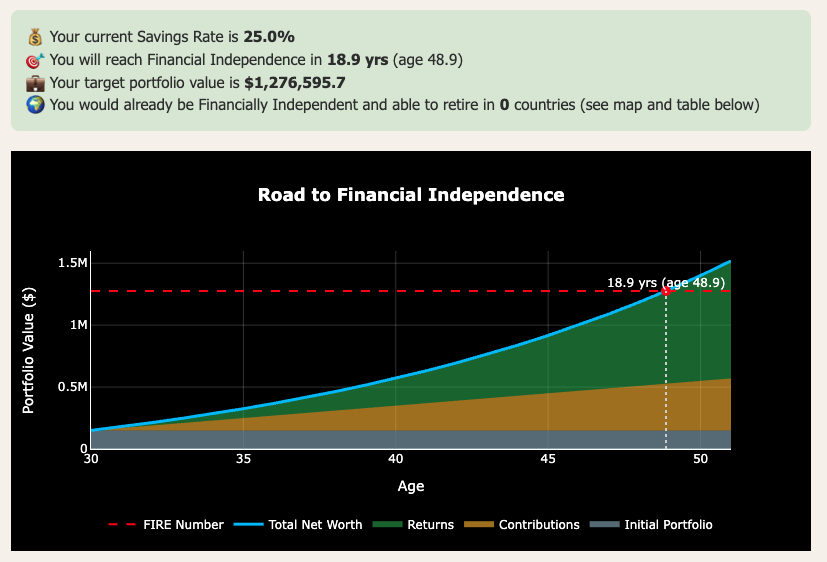
Figure 1: Screenshot of out Financial Independence Calculator (free; email unlock)
As mentioned, the values presented until now refer to traditional 30-year retirement timelines, not for very early retirees in the FIRE community, who can face—in extreme cases—retirement timelines of up to 60-70 years. Thankfully, Bengen also provides some analysis for these longer term periods. Specifically, Bengen’s analysis supports a conservative withdrawal rate floor of 4.1% when using his diversified portfolio.
This new analysis offers encouraging news for early retirement planners. Previously, many FIRE enthusiasts questioned the reliability of using the 4% rule and advocated for much more conservative withdrawal rates of even 3%. In the example above, this would mean needing to accumulate a $2M portfolio, $500,000 more than by using the 4% rule. For most, saving an additional $500,000 translates naturally into a much longer career.
It’s important to note that the 4.1% withdrawal rate reflects the worst-case scenario. If you have good understanding of your spending and are willing to have some built-in flexibility in your budget, this 4.1% is likely to be very conservative.
Personally, I’ve always felt the original 4% rule was too conservative. My current plan uses a 5% safe withdrawal rate with guardrails, a variable spending approach that would let me retire a few years earlier than if I’d follow the 4% rule. For me, it’s a small trade-off in flexibility for a huge gain in life satisfaction. (See also: Why Flexibility Beats a 3% SWR in Early Retirement).
In terms of asset allocation, Bengen recommends maintaining 100% stocks during the accumulation phase to maximize portfolio growth (of course, only if it is appropriate to your risk tolerance). Five years before retirement, Bengen recommends shifting gradually towards a balanced portfolio that you will maintain in retirement, such as a 60/40 or 55/45 stocks-to-bonds allocation.
The reason for not changing your allocation at retirement (instead of 5 years earlier) is that, if you are unlucky, a stock market downturn could severely push back your retirement timeline. The more determined you are with reaching retirement at a specific date, the more important it becomes to start this transition a few years before retirement.
Benefits of Using Bengen’s Updated 4.7% Rule for Early Retirement
Like the 4% rule, the biggest strength of the 4.7% rule is its simplicity. It provides a simple benchmark for setting your financial independence goals. The updated rule is grounded in a more sophisticated understanding of portfolio diversification, and likely mirrors more closely an internationally diversified portfolio.
The 4.7% rule is also based on worst-case scenarios tested in historical data. Despite being higher than the original rule, it remains very conservative for a retiree facing a traditional 30-year retirement timeline. For someone just starting to plan their retirement, using this updated figure is encouraging, since it can help them shave off some years from their Financial Independence timeline.
Limitations and Critiques: When 4.7% (and 4.1%) Make More Sense
A key limitation is that the 4.7% rule is based on a 30-year retirement horizon. If you plan for a longer timeline, say, of 40, 50, or more years, and you insist on using a fixed withdrawal strategy—one that withdraws a constant amount each year irrespective of market conditions—you will want to reduce the rate closer to 4.1%, especially if your biological age suggests you might live well beyond average life expectancy.
My recommendation here would be to at least look into dynamic withdrawal strategies (e.g., Guardrail Withdrawal Strategy or Variable Percentage Withdrawal), which will allow you to use higher withdrawal rates in exchange for some flexibility.
Another key concern for me is the issue with overfitting in Bengen’s model.As with any model rooted in backtesting, optimizing too strongly for portfolio mixes using past data can give us the illusion of safety without guaranteeing future success. Market conditions are always evolving, and future scenarios may differ significantly from historical data used in Bengen’s tests. It’s important to keep this in mind and that the optimally diversified portfolio over the next 30 years may differ substantially from Bengen’s.
That said, this doesn’t mean the 4.7% rule is invalid. It simply means investors should treat it as a starting point, not a guarantee. Future inflation, global diversification, and interest rate trends could all influence what’s “safe” going forward. Personally, I find that having some built-in lifestyle flexibility in your plan is also very important and can help you better stomach the uncertainty.
Fixed withdrawal strategies ignore sequence of return risk (SORR) and lack dynamic adjustments for market volatility. SORR is particularly important for early retirees facing a longer than 30-year retirement timeline. We covered in a previous post how to protect yourself from SORR by using a bond tent approach, explored why flexibility can often beat a 3% safe withdrawal rate in early retirement, and have also discussed two dynamic withdrawal strategies that can overcome most of the drawbacks of using the 4%/4.7% rule, e.g., withdrawals using guardrails or Variable Percentage Withdrawal (VPW).
These strategies are crucial for longer retirements, especially for early retirees who might spend 40–50 years in retirement. Understanding when to use 4.1% vs. 4.7% could come down to your own risk tolerance and ability to be flexible: the more adaptable your spending is, the higher your safe withdrawal rate can realistically be.

Alicante, Spain. Spain ranked 2nd in our top 5 retirement destinations in Europe. Photo by Dean Milenkovic on Unsplash.
My Withdrawal Strategy: How I Apply the 4.7% Rule with Flexibility
In spite of the limitations disclosed above, I personally find very encouraging that, through the backtesting of a diversified portfolio, the very worst case scenario was a 4.7% withdrawal. If you want to play it very safe, though, one approach could be to use this 4.7-5% as a means to calculate your Financial Independence number, but then rely on one of the dynamic withdrawal approaches linked above (guardrails, VPW, or similar).
My favourite approach (so far) is to use a 5% withdrawal rate, combined with guardrails, and a bond tent at retirement. I like the clarity of a fixed number to determine your Financial Independence number and timeline, but prefer to stay flexible when it comes to implementation, always making small adjustments on spending as the stock market and economic conditions evolve.
Flexibility in spending allows you to enjoy higher income during retirement while managing risk. People like to geek out about whether a 3.25%, 3.5% or 4% fixed safe withdrawal rate is optimal, but, really, your ability to be flexible in spending is likely far more important.
I also plan to use tools like the “bond tent” approach to mitigate sequence of return risk (SORR). I plan to gradually increase bond exposure at retirement and during the first 3-5 years thereafter to protect my portfolio in the long term.
Before jumping on board with this approach, though, please note that this responds to my very particular circumstances and risk tolerance.
Final Thoughts: Flexibility, Guardrails, and Smarter Retirement Planning
Bengen’s updated 4.7% rule certainly represents a meaningful evolution in retirement planning. It reflects how a more diversified portfolio would have performed in the past, and, while not perfect, gives us a guideline for what to expect moving forward.
If you take one thing away from today’s post, though, let it be the importance of flexibility. Combining diversified portfolios with dynamic withdrawal strategies is a powerful recipe for retirement success. It’s important to understand the assumptions behind safe withdrawal rate calculations—and to separate fact from fiction when it comes to Financial Independence—and tailor them to your own risk tolerance, spending flexibility, and retirement goals.
If you enjoyed this article, here are some next steps:
👉 Calculate your FI number using 4%, 4.7%, and flexible scenarios (free, email unlock)
👉 Stress-test 4.7% on your own FI plan: see our ProjectionLab walkthrough
👉 Explore guardrails or VPW for execution
👉 Subscribe to access free tools and our monthly newsletter with new articles and insights
🌿 Thanks for reading The Good Life Journey. I share weekly insights on personal finance, financial independence (FIRE), and long-term investing — with work, health, and philosophy explored through the FI lens.
Disclaimer: I’m not a financial adviser, and this is not financial advice. The posts on this website are for informational purposes only; please consult a qualified adviser for personalized advice.
Check out other recent articles





























About the author:
Written by David, a former academic scientist with a PhD and over a decade of experience in data analysis, modeling, and market-based financial systems, including work related to carbon markets. I apply a research-driven, evidence-based approach to personal finance and FIRE, focusing on long-term investing, retirement planning, and financial decision-making under uncertainty.
This site documents my own journey toward financial independence, with related topics like work, health, and philosophy explored through a financial independence lens, as they influence saving, investing, and retirement planning decisions.
Frequently Asked Questions (FAQs)
-
No. Bill Bengen did not “replace” the 4% rule with a new universal standard. Instead, he showed that under a more diversified portfolio, the worst-case historical withdrawal rate over 30 years increased to 4.7%. It’s an update to the underlying assumptions—not a blanket rule for everyone.
-
No. The safe withdrawal rate depends on portfolio composition, retirement length, risk tolerance, and spending flexibility. While 4.7% held up in worst-case historical tests for a specific diversified portfolio, many retirees may still prefer lower or more flexible rates.
-
Bengen revisited the 4% rule to account for broader diversification beyond large-cap U.S. stocks and intermediate-term bonds. By including additional equity categories and cash, he found that portfolios became more resilient, supporting higher sustainable withdrawals in historical testing.
-
A lower rate around 4.1% makes more sense for very long retirements (40+ years) if you plan to use a fixed, inflation-adjusted withdrawal strategy. It reflects a conservative floor in Bengen’s analysis when portfolios must last far longer than the traditional 30-year horizon.
-
The 4.7% rule assumes a highly diversified portfolio: roughly 55% stocks spread across U.S. large-, mid-, small-, micro-cap, and international equities, plus 40% intermediate-term government bonds and 5% cash. The diversification—not optimism—drives the higher withdrawal rate.
-
Using 4.7% instead of 4% reduces the required portfolio size by about 15%, which can meaningfully shorten the path to financial independence. For early retirees, however, the rule works best as a planning benchmark, paired with flexibility during market downturns.
-
The biggest risk is treating it as a rigid spending rule. The analysis is based on historical data and assumes a specific portfolio structure. Future market conditions, inflation regimes, or behavioral constraints may differ, making adaptability more important than the exact percentage.
-
Sequence-of-returns risk matters most early in retirement, when withdrawals coincide with market declines. Even a historically “safe” rate like 4.7% can fail if early losses are severe and spending remains inflexible, which is why diversification and risk management tools matter.
-
For long retirements, yes. Strategies like guardrails or variable percentage withdrawals adjust spending based on portfolio performance, reducing the risk of depletion. Many retirees use a fixed rate like 4.7% for planning, then switch to dynamic rules for implementation.
-
There is no single best strategy. Early retirees often benefit from combining a higher planning rate (such as 4.7–5%) with flexible spending rules and tools like bond tents. The ability to adapt spending typically matters more than choosing the “perfect” percentage.
Join readers from more than 100 countries, subscribe below!
Didn't Find What You Were After? Try Searching Here For Other Topics Or Articles: