
Thailand usually performs very well in best countries to retire in Asia. Photo by Ivan Nedelchev on Unsplash.
Reading time: 9 minutes
Quick answer:
The best countries for geographic arbitrage are those that combine a lower cost of living with strong safety, healthcare, stability, and a climate you’ll actually enjoy long-term.
👉 New to geographic arbitrage? Start with our complete guide to retiring abroad using geographic arbitrage before narrowing down countries.
What you’ll get from this guide 🌍
✔ A clear framework to choose the best countries to retire early
✔ How cost of living and lifestyle trade off in geographic arbitrage
✔ Why “cheapest” is rarely the best retirement destination
✔ A data-driven way to shortlist countries without overwhelm
✔ How to use safety, healthcare, climate, and stability to avoid regret
✔ When regional lists help—and when they mislead
✔ How to turn rankings into real relocation decisions
TL;DR — Geographic Arbitrage & Early Retirement 🧭
💰 Lower cost of living = smaller FI number and earlier retirement
🌍 The “best” country often depends on constraints, not rankings
⚖️ Safety, healthcare, and stability can matter as much as price
📊 Use a framework first—lists come after
🛠️ Tools + shortlists beat endless research
🔁 Geographic arbitrage is a lever, not a one-time decision
If you want a quick shortlist, jump to Figure 1 below and to our Retirement Relocation Tool. If you want to understand the method, read the criteria and cutoffs below.
Where Can You Retire Early & Live Comfortably? Top Picks for 2026
Geographic arbitrage is one of the most powerful levers for FIRE (Financial Independence, Retire Early): if you choose to retire in a country where your cost of living is lower, you need a smaller portfolio—a reduced Financial Independence number—to fund the same lifestyle. This means you can reach Financial Independence much faster.
The hard part isn’t wrapping your mind around the concept, but narrowing down on a desirable set of countries and actually choosing where to go.
In this guide, I’ll present a data-driven approach to shortlist the best countries for early retirement in 2026—by balancing cost of living with safety, healthcare quality, pollution, and climate. At the end, you can also use our free, interactive Retirement Relocation Tool to filter countries based on your personal preferences.
This article focuses on the decision framework and shortlisting logic; the Retirement Relocation Tool implements this framework in a fully interactive, customizable way and is documented separately.
If you already have a region in mind you’d like to retire to, I’ll also link to my Europe, Asia, Latin America, and Nordics deep-dive articles, which rank some of the best locations per region.
How to Shortlist the Best Countries to Retire Early Abroad (Geographic Arbitrage Framework)
There are numerous challenges for selecting suitable countries for geographic arbitrage. Firstly, the sheer amount of options for relocation can make the choice overwhelming—a clear case of paralysis by analysis. We don’t know where to start, so we just don’t consider seriously the option of geographic arbitrage itself. I built this framework because I found that without a shortlist method, “retire abroad” research can turn into endless tabs and no decisions.
Secondly, we often already hold strong strong views—founded or unfounded—on certain countries, while we may be completely unaware of other countries that may be excellent matches to our specific circumstances and preferences.
Let’s try to keep the emotions aside for a moment and come up with a step-by-step, data driven approach that allows us to narrow down on potential top destinations based on variables we consider important. This framework intentionally focuses on the highest-impact variables needed to build a first shortlist; more nuanced lifestyle, expat, and personal-preference filters are layered on later in the interactive Retirement Relocation Tool.
Important note on scope: This article focuses on which countries are best suited for geographic arbitrage in early retirement, based on cost of living and quality-of-life factors. If your main question is how many years geographic arbitrage can cut off your FIRE timeline, we walk through that math step-by-step using real examples in the linked text above.
For the broader context—including how geographic arbitrage affects retirement timelines, taxes, and lifestyle trade-offs—see our full geographic arbitrage guide.

Cancun, Mexico. Mexico recently ranked 4th in our list of best countries to retire in Latin America. Photo by Aman on Unsplash.
What Makes a Country Ideal for Early Retirement?
While identifying suitable country characteristics is to a large degree subjective and depends on your personal circumstances, my hope is that readers can reproduce this general process, adjusting for the variables that are critical to them. Below we find a comprehensive list of important quantitative and qualitative variables to consider. If I were to retire, say, in a decade or so to a foreign country, I would want it to perform strongly in the following areas. The subsequent Table 1 summarizes the available data to be considered to narrow down the scope.
Cost of living. This is one of the main variables we want to use for this analysis. By choosing affordable retirement destinations, we can fast-track our journey to financial independence while enjoying a higher quality of life.
Affordable housing. Affordable housing is also a critical variable to ensure a comfortable retirement with our available savings.
Health care system. Another important element to consider. We want to live healthy, long lives. While a large part of our health is determined by our lifestyle choices, it is still important to have a solid health care system supporting you when needed. Ideally, this should be both affordable and of high quality.
Safety. Moving to a safe country for early retirement is crucial for peace of mind. This variable should account for crime rates and the general sense of safety perceived in the country. For most early retirees, “safe enough” is non-negotiable—even if it costs a bit more.
Political, legal and financial stability. We want to move to a politically stable environment with very low risk of civil unrest. Ideally, we also want to enjoy acceptable levels of governance and political stability.
Tax environment. This is a very relevant factor. If we plan to live off our investment portfolios, how our wealth is taxed determines to a certain extent how far we can stretch our retirement budget. When considering the tax environment of a country we should not only consider capital gains tax, but also potential treaties and benefits for foreign retirees. Property taxes and inheritance tax considerations may also be of importance, depending on your unique circumstances.
Environment. Environmental factors like favorable climate, low natural disaster risk, clean air and water, and abundant natural beauty are important when choosing the best countries for retirement.
There are certainly other relevant factors to consider that we won’t include for now in this article (but some of which will be included in the tool as they become available). After identifying the top countries for early retirement, consider these additional factors to make your final relocation decision. Consider for instance:
Proximity to friends and family. Consider proximity to your home country and ease of travel when selecting the ideal retirement destination abroad.
Cultural openness and attitude towards expats: Choosing expat-friendly countries with welcoming cultures ensures a smoother transition into your new early retirement life. This could be informed, for example, by the “Ease of settling in index” from InterNations.
Education: This may be a highly relevant category for early retirees with children.
Language. Consider the prevalence of English or other common languages, availability of language schools or immersion programs with local language, and general ease of communication for non-native speakers.
Retirement benefits and pension transferability. This doesn’t apply so much to early retirees (at least at first), but some factors to consider could be the ability to receive and transfer pensions to the country of residence or social security agreements between countries. And once that pension, Social Security, or portfolio withdrawal does arrive, remember it lands in your home currency—how you convert it into local currency can be the difference between losing a few dollars and losing thousands a year.
Local cuisine and dining options. Exploring countries with rich culinary traditions can enhance your early retirement experience, especially if you're a food enthusiast.
Travel options within country or region.
Cultural and social life: opportunities for cultural engagement such as museums, theaters, concerts, festivals. Opportunities for hobbies and activities (sports, clubs, etc.)
In practice, visas/residency rules, healthcare access, and social fit often eliminate countries that look perfect on paper. I think it’s best to use rankings to shortlist a set of candidate countries—then validate what the reality is (visa, taxes, insurance, community) before committing.
There's one more limitation worth addressing: this analysis captures today's cost advantage, not tomorrow's. Popular destinations like Portugal and Thailand have already seen meaningful cost increases over the past decade—driven by foreign demand, currency movements, and economic development. Our article on geoarbitrage and rising costs covers what drove those changes and how to stress-test your FIRE plan against them.
While most people associate geographic arbitrage—or even seasonal geoarbitrage—with cheaper destinations, sometimes attractive opportunities emerge even in higher-cost countries—as our Denmark vs Germany comparison shows: lower housing costs can sometimes outweigh higher taxes and general living expenses.
In today’s analysis, though, we consider the quantitative variables found in Table 1. These key factors help narrow down the best countries for affordable early retirement, though other considerations may also influence your choice.

Porto, Portugal. Portugal recently ranked 1st as top retirement hotspot in Europe. Photo by Nick Karvounis on Unsplash.
Table 1: Variables considered for the identification of suitable locations for geographic arbitrage and financial independence.
| Variable | Comment | Source |
|---|---|---|
| Cost of living | Considers rent | Numbeo (2024) |
| Health care system | Considers healthcare professionals, equipment, staff, doctors, and costs. Provides assessment of healthcare infrastructure, services, and resources | Numbeo (2024) |
| Safety | General sense of security | Numbeo (2024) |
| Political, legal, and financial stability | 6 key indicators included: Voice and accountability; Political stability and absence of violence; Government effectiveness; Regulatory quality; Rule of law; and Control of corruption | World Bank indicators |
| Pollution | Air pollution is given strongest weight, but other factors also considered: water pollution, garbage disposal, cleanliness, noise and light pollution, green spaces, and comfort in relation to pollution | Numbeo (2024) |
| Climate | Estimation of climate likability | Numbeo (2024) |
Analyzing the Best Countries for Affordable Early Retirement through Geographic Arbitrage
Using the six key variables from Table 1, Figure 1 illustrates how countries compare in cost of living and retirement suitability, helping you find the ideal location for early retirement. These suitable conditions are represented by an index (a composite Retirement Suitability score, x axis), which accounts for 5 variables of Table 1: health care system; safety; political, legal, and financial stability; pollution; and climate.
The initial dataset contains 121 different countries. Different cut-off criteria are proposed for the different variables, since ideally we don’t want our retirement location to be too dangerous, offer a poor health care system, or have extreme levels of air pollution.
The methodology section presents more information on how the retirement suitability index is derived and how we arrive at the set of 51 countries in Figure 1 based on different cut-off criteria. For now, keep in mind that 70 countries have already been removed from Figure 1 for not meeting different suitability criteria.
From this point on, narrowing down further on a smaller set of candidate countries depends a lot on your starting point. For example, if you live and work in Switzerland (top right corner of Figure 1), congratulations, the world is your oyster! You will be doing geographic arbitrage literally in any location you choose to retire to. If you choose to retire in relatively expensive Denmark your expenses may still be roughly 40% lower than you are used to.
Of course, this is a very extreme case, but you get the idea. Similar geographic arbitrage opportunities will also exist for those living and working in high cost of living countries, e.g., Iceland, United States, Australia, Norway, Luxembourg, etc.
As observed in Figure 1, there is a positive correlation between the two variables. For the purposes of our assessment this means we should consider the obvious trade-offs. For example, if we live in Austria, we can look at the chart and start going down vertically (searching for lower cost of living countries). However, notice that the further down we go, our search inevitably takes us “to the left” towards countries with lower retirement suitability scores.
Spain, Portugal, or Croatia may be very strong initial choices for someone based in Austria. If we go further down the cost of living ladder we may find Mexico or Turkey, but Mexico scores poorly on pollution and just barely makes it into safety cut-off group (see methodology section below).
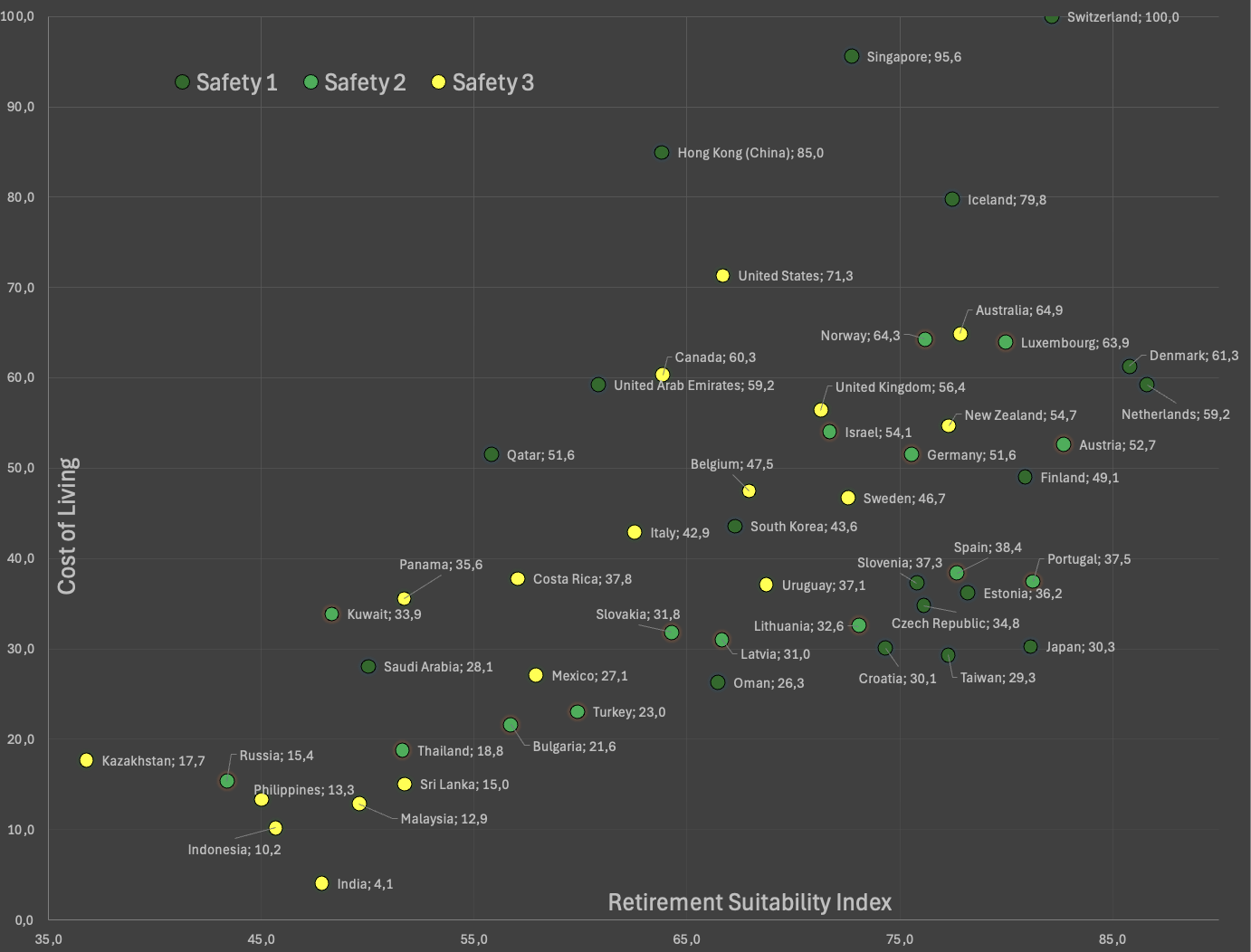
Figure 1. Cost of Living versus Retirement Suitability Index for 51 countries. Y axis represents the cost of living, while the x axis is a composite Retirement Suitability Index that includes 5 variables from Table 1. The three color categories reflects one of the variables included in the index, namely the country's safety. Dark green is safest, yellow least safe. Countries falling in categories 4 and 5 were removed from the selection process—see Methodology section below for details on selection criteria on how we arrived at 51 countries from an initial set of 121. Check out our interactive Retirement Relocation Tool (free for email subscribers), where you can select and modify the different criteria that are important to you to identify a small set of suitable countries to retire to. At present, it only works for PC.
I am aware that this chart won’t immediately solve your relocation decision. But my hope is that it serves as a useful first step in mapping and evaluating where your country stands in relation to others, both in terms of cost of living and other desirable retirement location characteristics. Perhaps it encourages you to make your own Retirement Suitability Index based on the factors you consider important.
Of course, as mentioned previously, once you identify a set of 5-7 possible countries, you should then account for other important factors in order to make a balanced choice. Consider, for example, proximity to friends and family, cultural openness and attitude towards expats, language, retirement benefits and pension transferability, local cuisine, travel options, and cultural and social life.
In upcoming posts, we'll delve into how geographic arbitrage can significantly reduce the time to achieve Financial Independence and the impact of tax regimes on your early retirement plans.
Want region-specific shortlists? (Deep dives)
If you already know which region you’re considering, these posts go deeper with rankings and country-by-country notes: Europe, Asia, Latin America, and Nordics.
Methodology
Methodology note (important): This article presents the core framework originally used to identify strong geographic-arbitrage candidates—focusing on cost of living, safety, healthcare, stability, pollution, and climate.
Since publishing this article, the Retirement Relocation Tool has expanded this approach further. The tool now incorporates additional lifestyle and expat-relevant variables (e.g., English proficiency, expat openness, natural scenery, and disaster risk), allowing readers to customize weights and constraints based on personal priorities.
Think of this article as the conceptual backbone—and the tool as the fully customizable, up-to-date implementation of the same idea. If you’re interested in the full variable set, data sources, sliders, and limitations, see the dedicated article explaining how the Retirement Relocation Tool works.
This approach that was followed for this specific article—the output presented in Figure 1—is as follows:
We start out with 121 countries in our dataset
We consider the cost of living of these countries and their suitability for retirement, depicted by the Retirement Suitability Index. This index averages scores across health care system; safety; political, legal, and financial stability; pollution; and climate. Sources were presented in Table 1.
All variables in the dataset are normalized (0-100) prior to combining in the index. The Retirement Suitability Index is the average score across the five categories.
Additionally, for each of the five variables, we categorize countries as 1-5. For example, if you score 84 in safety you are in group 1 for safety (the best), whereas if you score 33 in healthcare you are in group 4 for safety (the second worse group).
We reduce the scope of countries from 121 to 51 through the following steps:
If there is two or more NAs across the five variables of the index, the country is removed from the dataset (28 countries removed)
Countries from safety groups 4 and 5 are removed (15 further countries removed)
Countries from health care system groups 4 and 5 are removed (22 further countries removed)
Countries from political, legal, and financial stability group 4 and 5 are removed (2 further countries removed)
Countries from pollution 5 group removed (3 further countries removed)
Final 51 countries considered: Australia, Austria, Belgium, Bulgaria, Canada, Costa Rica, Croatia, Czech Republic, Denmark, Estonia, Finland, Germany, Hong Kong, Iceland, India, Indonesia, Israel, Italy, Japan, Kazakhstan, Kuwait, Latvia, Lithuania, Luxembourg, Malaysia, Mexico, Netherlands, New Zealand, Norway, Oman, Panama, Philippines, Portugal, Qatar, Russia Saudi, Arabia, Singapore, Slovakia, Slovenia, South Korea, Spain, Sri Lanka, Sweden, Switzerland, Taiwan, Thailand, Turkey, United, Arab Emirates, United Kingdom, United States, Uruguay.
Enjoyed this post? Don’t miss our insights on reaching the crossover point for financial independence or the importance of taxes in retirement destinations for early retirement.
🌿 Thanks for reading The Good Life Journey. I share weekly insights on personal finance, financial independence (FIRE), and long-term investing — with work, health, and philosophy explored through the FI lens. If this resonates, join readers from over 100 countries and subscribe to access the free FI tools and newsletter.
👉 New to Financial Independence? Check out our Start Here guide—the best place to begin your FI journey.
Disclaimer: I am not a financial adviser, and this content is for informational and educational purposes only. Please consult a qualified financial adviser for personalized advice tailored to your situation.
Check out other recent articles





























About the author:
Written by David, a former academic scientist with a PhD and over a decade of experience in data analysis, modeling, and market-based financial systems, including work related to carbon markets. I apply a research-driven, evidence-based approach to personal finance and FIRE, focusing on long-term investing, retirement planning, and financial decision-making under uncertainty.
This site documents my own journey toward financial independence, with related topics like work, health, and philosophy explored through a financial independence lens, as they influence saving, investing, and retirement planning decisions.
Frequently Asked Questions (FAQs)
-
Geographic arbitrage means retiring in a country where your cost of living is lower than where you earned your income, allowing the same portfolio to fund a higher quality of life or a longer retirement. For a comprehensive overview of all geoarbitrage strategies (retirement, seasonal, and accumulation), see our complete guide here.
-
There is no single best country. Strong candidates balance affordability with safety, healthcare quality, political stability, and climate—factors we combine into a Retirement Suitability Index in this guide.
-
Depending on income and spending, relocating to a lower-cost country can reduce the required FI portfolio by 20–60%, often shortening the timeline by several years.
-
No. Geographic arbitrage works for LeanFIRE, standard FIRE, and even FatFIRE—it simply changes how far your money goes relative to your desired lifestyle.
-
es. Capital gains taxes, pension taxation, and tax treaties can meaningfully affect retirement budgets and should be evaluated alongside cost of living.
-
Many countries offer high-quality, affordable healthcare, but access, insurance requirements, and language barriers vary significantly.
-
Safety varies widely by country and region. This guide explicitly excludes countries with poor safety scores to reduce downside risk.
-
Yes. Many retirees start with slow travel or seasonal stays before committing to a permanent move.
-
Sometimes. Lower housing costs or favorable tax treatment can offset higher prices, as shown in certain European comparisons.
-
Start with data (cost, safety, healthcare), narrow to 5–7 candidates, then layer in personal factors like language, culture, and proximity to family.
-
It depends on what you optimize for. Europe often wins on healthcare access and infrastructure, Asia on affordability, and Latin America on proximity/time zones for US retirees. The best approach is to shortlist by your constraints (budget, safety, climate, language) first, then compare countries within the region.
-
Start with a framework if you want a decision you won’t regret. Lists are useful once you know what matters to you, but they often hide trade-offs. This guide gives you a structured shortlist; the regional posts help you go deeper once you’ve narrowed your options.
Join readers from more than 100 countries, subscribe below!
Didn't Find What You Were After? Try Searching Here For Other Topics Or Articles: