
Broken Beach, Bali, Indonesia. Indonesia ranked in our top 3 retirement destinations in Asia. Photo by Chaitanya Maheshwari on Unsplash.
Reading time: 8 minutes
Updated October 2026: The tool now covers 152 countries (up from 106), uses the latest available data for every factor, and adds a new factor, Life Expectancy at 60. Safety, Pollution, Climate, and Natural Disaster now use more improved measures. Returning user? See what changed at the end of this article.
The Retirement Relocation Tool helps you shortlist countries to retire to by plotting cost of living (COL) against a “retirement suitability” score built from 10 factors (safety, healthcare, political stability, air quality, climate, life expectancy, and more) across 152 countries. This page explains how the tool works, where the data comes from, and how to best interpret its output.
Not looking for a methodology? Check out other relevant articles:
Curious about a lifestyle variant that doesn’t require permanent relocation? Learn about Seasonal Geoarbitrage
Check out are regional retirement rankings: where are the best countries to retire to across Europe, Asia, Latin America, or the Nordics?
Retirement Relocation Tool: How It Works (Methodology + Limitations)
This article explains the methodology behind the Retirement Relocation Tool (Figure 1 below; PC only; free for email subscribers), answers common FAQs, and highlights the model’s known limitations.
In our complete guide to geographic arbitrage and FIRE, we introduced the core decision logic for choosing retirement countries (cost of living plus quality-of-life constraints like safety, healthcare, stability, pollution, and climate). This tool builds on that foundation by adding more factors and letting you choose which ones count and how strict to be on each.
Our Retirement Relocation Tool helps users find their ideal retirement destination by filtering key factors like cost of living, healthcare, climate, and many others. We first launched it in February 2025 after feedback from several FI communities on Reddit, and gave it a major data update in October 2026.
This tool serves as a starting point to shortlist countries that fit your individual constraints and preferences, so you can narrow down your choices to a handful of different candidate countries. However, the tool does not replace the need for serious due diligence on a whole set of other factors that are important when deciding where to relocate to (more on this later).
In today’s post, we lay out the methodology underlying the tool, answer FAQs based on feedback received, and disclose any data and methodology limitations that users should be aware of.
How the Retirement Relocation Tool Scores Countries (Method Overview)
The tool generates a visual ranking of countries, plotting a Retirement Suitability score against Cost of Living (COL) to help users compare top retirement destinations. The Retirement Suitability score is an average of 10 factors relevant to choosing where to retire: Safety, Healthcare, Political Stability, Pollution, Climate, English Proficiency, Openness, Natural Scenery, Natural Disaster risk, and Life Expectancy at 60. Table 1 below describes each factor, its source, and how many countries it covers.
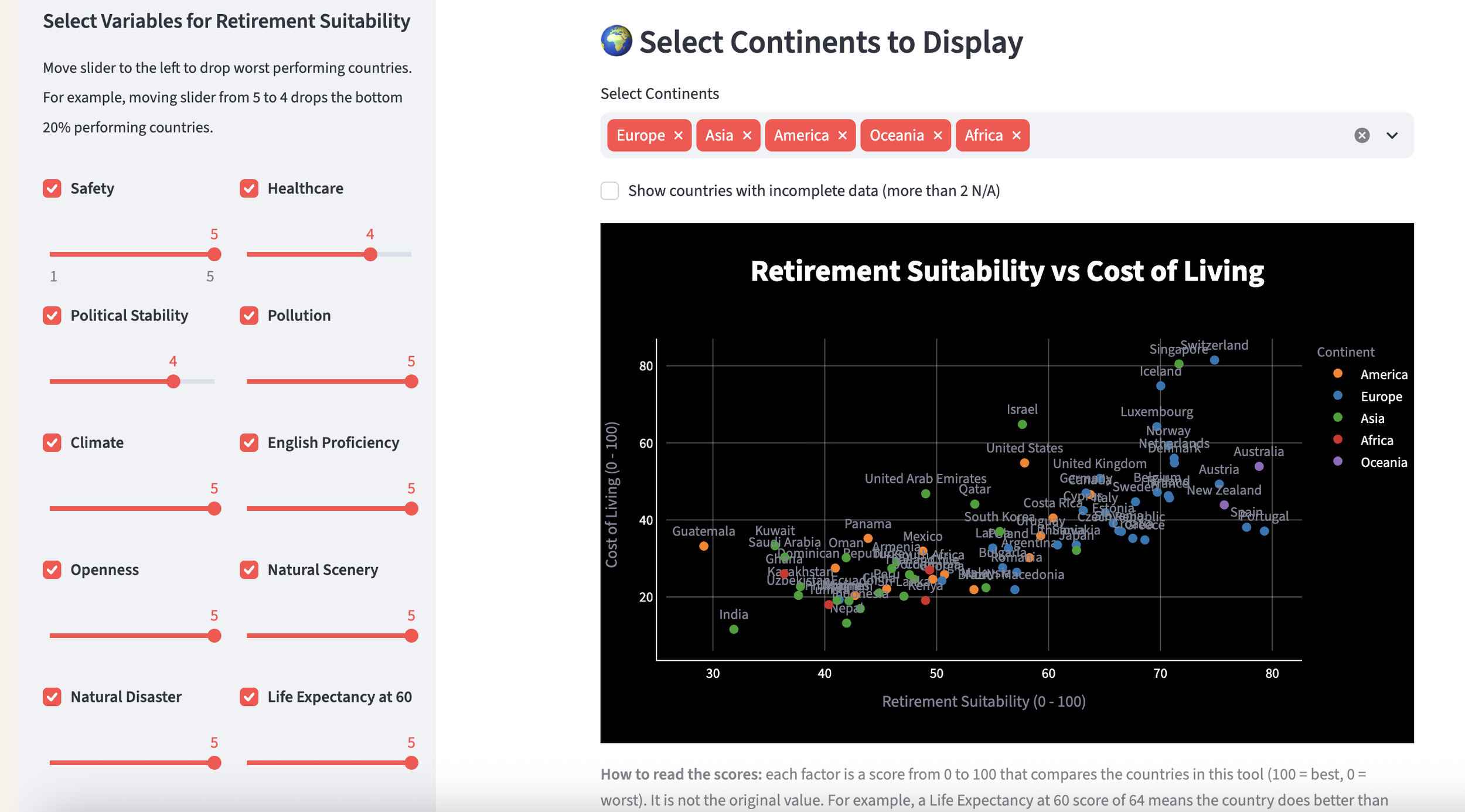
Figure 1. Screenshot of the Retirement Relocation Tool (PC only; free for email subscribers). The user can use the sliders on the left of the dashboard to determine how important they consider each of the 10 factors to be. The plot then updates the Retirement Suitability score to reflect that personalized preference. To illustrate, moving the Safety lever from 5 to 3 would drop the worst 40% performing countries on that metric. In the end, countries appearing on the bottom right tend to be best—combining low COL with high retirement suitability.
As observed in the screenshot on Figure 1 above, the left panel of the tool presents the 10 factors that make up the Retirement Suitability score. Users can customize their rankings by selecting or deselecting key factors, allowing the tool to dynamically recalculate results based on their priorities.
In addition, each variable has a slider, which can be moved from 5 (includes all countries) to 1 (includes only top 20% of countries). For example, if we move a slider from 5 to 4, we are dropping from the plot the worst 20% performing countries in that variable. If we move the slider all the way to 1, we are keeping only the top 20% performers in that variable.
These sliders allow the user to define how important these factors are and how strict they want to be with them. One user may want to set Healthcare to 3, while another may consider English Proficiency to be very important and set it to 2.
Users can refine their results by selecting specific continents, helping them focus on regions that meet their preferences. You can remove continents directly above the plot, and this will drop all relevant countries of said continent. Not every data source covers every country, so by default the tool hides countries missing more than 2 of the 10 factors (94 of 152 countries are shown). Tick the box above the chart to also show countries with incomplete data.
At the top, clear instructions guide users on how to get the most accurate results from the Retirement Relocation Tool.
How the scores are calculated
Each factor is converted into a score from 0 to 100. Countries are ranked on each factor, and the best country gets 100 while the worst gets 0. Countries with identical values share the better score. This puts factors measured in very different units (e.g., homicides per 100,000 people, outdoor hours per year, or years of life) on the same scale.
Scores compare countries in the tool; they are not the original values. For example, a Life Expectancy at 60 score of 64 means the country does better than about 64% of the countries in the tool, not that people live to 64. Scores are always calculated across all 152 countries, so a country’s score stays the same whether or not incomplete countries are shown.
Retirement Suitability is the simple average of the factors you select. All selected factors count equally. If a country is missing a factor, its average uses the factors it has. Hover over any country to see which factors are missing (“NA”).
Cost of Living is not converted. It is Numbeo’s Cost of Living Plus Rent Index, where New York = 100.
Limitations
Think of this tool as a way to build your shortlist, not to pick a winner. Use it to narrow down candidates, then examine them carefully before deciding. In particular:
Taxes and visas are not included. Both depend on your nationality, income sources, and personal situation, so a single country score would be misleading. See as a starting point, for example, our articles on capital gains tax or exit tax.
Scores are national averages. For some factors, scores can vary more within a country (coastal vs. inland Spain, Florida vs. Minnesota) than between neighbouring countries.
Some factors rely on surveys. Healthcare and Cost of Living come from Numbeo’s crowdsourced data, where samples can be small in some countries. Scenery and Openness are based on opinion surveys, and Openness covers only 53 countries. On the other hand, crowdsourced data often reflects the cities expats actually live in, rather than national statistics.
Some countries have gaps. Small territories and places outside UN datasets (e.g., Taiwan) are missing several factors.
Scores are relative. Adding countries or updating one source can shift other countries’ scores slightly. When comparing versions of the tool, look at a country’s overall position rather than individual factor scores.
Personal factors are not covered. These include your healthcare needs, language skills, family ties, and community fit.
How to use the tool (3 steps)
1) Decide which quality-of-life factors are non-negotiable. Use the sliders on the left to exclude the worst-performing countries in areas you care most about (e.g., safety and healthcare or political stability and climate). Moving a slider from 5 to 3 removes the bottom 40% of countries for that factor.
2) Read the chart in two dimensions: cost of living vs suitability. The plot shows cost of living on the y-axis and a composite retirement suitability score on the x-axis. Rather than “optimizing” a single country, look for clusters that sit meaningfully below your current cost of living while still scoring well on the factors you selected. Countries toward the bottom right offer the most for the least.
3) Shortlist candidates, then validate in the real world. Once you’ve identified a handful of countries that meet your constraints, move beyond the tool: check visas, healthcare access, taxes, language, and community fit. The tool is designed to narrow options, not to make the final decision for you.
Data Sources and Factors Used in the Retirement Relocation Tool
Table 1: Variables considered in the Retirement Relocation Tool.
| Variable | Source | Comment | Data Completeness |
|---|---|---|---|
| Cost of Living | Numbeo (2026 mid-year) | Cost of Living Plus Rent Index: local prices including rent, New York = 100. Crowdsourced from an expat-oriented platform | 152 of 152 countries |
| Safety | UN Office on Drugs and Crime, via Our World in Data (latest year, mostly 2022–2024) | Intentional homicide rate per 100,000 people | 145 of 152 countries |
| Healthcare | Numbeo (2026 mid-year) | Perceived quality of the healthcare system, incl. staff, equipment, speed and costs. Crowdsourced survey | 101 of 152 countries |
| Political Stability | World Bank Worldwide Governance Indicators (2025) | Average of six governance scores: voice and accountability, political stability, government effectiveness, regulatory quality, rule of law, and control of corruption | 149 of 152 countries |
| Pollution | IHME Global Burden of Disease, via World Bank and Our World in Data (2023) | Average exposure to fine-particle air pollution (PM2.5), weighted by where people live. Modelled from satellite and ground data | 143 of 152 countries |
| Climate | GeoRank (2026) | Comfortable outdoor hours per year (why we use it) | 95 of 152 countries |
| English Proficiency | Education First (2025) | English skills in non-native countries, based on test results. Native-English countries get the top score | 122 of 152 countries |
| Openness | InterNations (2024) | Ease of Settling In Index is composed of 3 sub-indicators: Finding Friends, Culture & Welcome, and Local Friendliness | 53 of 152 countries |
| Natural Scenery | US News (2024) | Survey of about 17,000 people living in 36 countries, who rated the scenery of 89 countries | 89 of 152 countries |
| Natural Disaster Risk | WorldRiskReport (2026) | Exposure to natural hazards such as earthquakes, storms, floods, droughts and sea-level rise | 141 of 152 countries |
| Life Expectancy at 60 | UN World Population Prospects, via World Bank (2024) | Average remaining years of life at age 60 (women and men averaged) | 149 of 152 countries |

Porto, Portugal. Portugal ranked as one of our top 5 retirement destinations in Europe. Photo by Nick Karvounis on Unsplash.
What changed in the October 2026 update
For users of the original February 2025 version:
Data and coverage
All factors refreshed with the latest available data (see Table 1).
Countries increased from 106 to 152: every country with Numbeo cost-of-living data is now included.
Countries missing more than 2 factors are now hidden by default (tick the box above the chart to show them).
New and improved factors
New: Life Expectancy at 60. It’s more relevant to retirees than life expectancy at birth, which is pulled down by infant and young-adult deaths.
Safety: Numbeo’s perceived safety survey replaced by actual homicide rates (UN Office on Drugs and Crime).
Pollution: Numbeo’s pollution survey replaced by measured air quality (PM2.5).
Climate: Numbeo’s climate score replaced by GeoRank’s comfortable outdoor hours.
Natural Disaster: now uses physical exposure to hazards only. The full WorldRiskIndex also scores a country’s social vulnerability, which overlaps other factors in the tool.
Political Stability: the World Bank changed its scale from percentile ranks to 0–100 governance scores, so the new values aren’t directly comparable with the old ones.
Openness and Natural Scenery: still use the 2024 editions. The 2026 InterNations ranking covers only 31 countries.
Corrections
South Korea had mistakenly been given North Korea’s values for Political Stability and Natural Disaster risk. This is fixed, and South Korea ranks considerably higher as a result.
If you are looking for more geoarbitrage content, here are some further articles:
👉 Cut 10 Years or more Off Your FIRE Timeline
👉 Seasonal Geoarbitrage, a lifestyle variant that doesn’t require permanent relocation?
👉 Our rankings: best countries to retire in Europe, Asia, Latin America, and the Nordics
👉 New to Financial Independence? Check out our Start Here guide
👉 Work with me: Check out out 1:1 FI Strategy Sessions
🌿 Thanks for reading The Good Life Journey. I share weekly insights on money, purpose, and health, to help you build a life that compounds meaning over time. If this resonates, join readers from over 100 countries and subscribe to access our free FI tools and newsletter.
Disclaimer: I am not a financial adviser, and this content is for informational and educational purposes only. Please consult a qualified financial adviser for personalized advice tailored to your situation.
Check out other recent articles





























About the author:
Written by David, a former academic scientist with a PhD and over a decade of experience in data analysis, modeling, and market-based financial systems, including work related to carbon markets. I apply a research-driven, evidence-based approach to personal finance and FIRE, focusing on long-term investing, retirement planning, and financial decision-making under uncertainty.
This site documents my own journey toward financial independence, with related topics like work, health, and philosophy explored through a financial independence lens, as they influence saving, investing, and retirement planning decisions.
Retirement Relocation Tool: FAQs
-
We chose factors that matter for retirement and that have reliable data for most countries. The tool currently uses 10: Safety, Healthcare, Political Stability, Pollution, Climate, English Proficiency, Openness, Natural Scenery, Natural Disaster risk, and Life Expectancy at 60. Two big factors are deliberately left out: taxes and visas. Both depend on your nationality, income sources and personal situation, so a single country score would be misleading. Please do your own due diligence. Our articles on capital gains tax and the exit tax when retiring abroad are a good starting point.
-
For each factor, countries are ranked and given a score from 0 (worst) to 100 (best), so every factor is on the same scale. The Retirement Suitability score is the simple average of the factors you’ve selected, and all selected factors count equally. Untick a factor to remove it from the average.
-
Each number is a 0–100 score showing how a country compares with the others in the tool, not the original value. For example, a Life Expectancy at 60 score of 64 means the country does better than about 64% of the countries in the tool, not that people live to 64. The original sources can be found in the table above.
-
Numbeo’s Cost of Living Plus Rent Index, where New York = 100. It reflects typical local prices, including rent, groceries, restaurants, transport, and housing. Your own costs may differ depending on your lifestyle, where in the country you live, and whether you rent or own.
-
Not every source covers every country. Small territories and some countries (e.g., Taiwan, which UN-based datasets don’t include) have gaps. By default, the tool hides countries missing more than 2 of the 10 factors. Tick the box above the chart to show them. When a country has gaps, its Retirement Suitability is the average of the factors it does have, so treat those countries with more caution. Hover over any country to see exactly which factors are missing (“NA”). On the map, countries with no data are grey.
-
Each factor uses a recognised international source, mostly from 2024–2026: the UN Office on Drugs and Crime (homicide rates), the World Bank (governance indicators), IHME (air quality), the UN (life expectancy), the WorldRiskReport (disaster exposure), GeoRank (comfortable outdoor hours), EF (English proficiency), InterNations (ease of settling in), US News (scenery), and Numbeo (cost of living and healthcare). Full details can be found in the table above.

Lisbon, Portugal. Portugal is a popular destination for retirees and scores very highly on our Retirement Relocation Tool. Photo by Vita Marija Murenaite on Unsplash.
Join readers from more than 100 countries, subscribe below!
Didn't Find What You Were After? Try Searching Here For Other Topics Or Articles: